


AI Compliance Debt: The New Technical Debt for AI Startups
AI startups are built to move quickly.
Teams ship models, launch features, integrate third-party AI services, and respond to customers at a pace traditional software companies often cannot match. That speed is a competitive advantage, but it can create a less visible problem: AI compliance debt.
The concept is similar to technical debt. Technical debt accumulates when engineering teams take shortcuts to move faster today, knowing those shortcuts may create maintenance costs later. AI compliance debt follows the same pattern.
A startup launches an AI feature without fully documenting its intended purpose. A risk assessment is postponed until an enterprise customer asks for one. AI systems are added to production without a centralized inventory. Vendor documentation sits in email threads. Governance policies are created after a procurement team requests evidence.
None of these decisions necessarily creates an immediate crisis.
But over time, they create a growing compliance burden.
With the EU AI Act changing the expectations around AI governance, this debt can become particularly expensive for startups selling into European markets. Organizations need to understand which AI systems they operate, how those systems should be classified, what risks they create, what documentation is required, and how those controls will be maintained over time.
The question for AI startups is no longer whether compliance matters.
It is whether compliance can scale as quickly as the AI business.
What Is AI Compliance Debt?
AI compliance debt is the accumulated operational work created when compliance activities are delayed, fragmented, or handled manually while an AI product continues to evolve.
It can include:
-
Missing AI system inventories
-
Outdated risk assessments
-
Incomplete technical documentation
-
Unclear AI ownership
-
Scattered compliance evidence
-
Untracked model changes
-
Inconsistent vendor assessments
-
Manual policy management
-
Limited monitoring
-
Unresolved compliance gaps
The problem is not necessarily that a startup is intentionally ignoring compliance.
More often, compliance simply loses the race against product development.
Engineering releases a new model. Sales signs a new enterprise customer. The product adds another AI capability. Compliance is expected to catch up afterward.
That approach becomes increasingly difficult as AI systems, customers, markets, and regulatory requirements expand.
Why AI Startups Accumulate Compliance Debt So Quickly
AI startups operate under unique pressures.
They need to demonstrate product-market fit, iterate quickly, satisfy investors, respond to customers, and compete with larger technology companies.
Compliance can therefore feel like something that belongs later in the growth cycle.
But AI products create governance requirements from the beginning.
Product Changes Create New Compliance Questions
An AI model that begins as a recommendation feature might later become part of an automated decision-making workflow.
A general-purpose AI feature might eventually be used in a regulated industry.
A customer may integrate the product into a high-impact business process.
Every change can affect the risk profile of the system.
Without structured governance, teams may not know when a new assessment or documentation update is required.
Enterprise Customers Accelerate the Problem
The first major compliance test for many AI startups is not a regulator. It is an enterprise customer.
A procurement or security team may ask:
-
What AI systems do you use?
-
How do you classify AI risk?
-
Do you have an AI governance policy?
-
How do you monitor AI systems?
-
Can you provide compliance documentation?
-
Are you prepared for the EU AI Act?
If the startup has managed compliance manually, answering these questions can delay the sales cycle.
This is where compliance debt becomes a commercial problem.
The EU AI Act Makes Compliance Debt More Expensive
The EU AI Act introduces a risk-based regulatory framework for AI systems. Depending on how an AI system is used, organizations may face different obligations.
For AI startups, understanding EU AI Act compliance starts with knowing what systems exist and how they are used.
Some applications may fall into prohibited or high-risk categories, while others may have transparency or other obligations.
For startups, the practical challenge is not simply understanding the regulation.
It is operationalizing it.
That requires repeatable processes for:
-
AI inventory
-
Risk classification
-
Risk assessment
-
Governance approvals
-
Documentation
-
Human oversight where applicable
-
Monitoring
-
Evidence management
This is why EU AI Act readiness should be treated as an ongoing business capability rather than a one-time compliance project.
AI Risk Classification: The First Place to Pay Down Compliance Debt
One of the earliest steps in reducing compliance debt is understanding the risk profile of your AI systems.
An organization cannot effectively govern what it has not identified.
A structured AI risk classification process should consider:
-
Intended purpose
-
Users and affected individuals
-
Decision-making impact
-
Deployment environment
-
Data processed
-
Applicable regulatory requirements
-
Whether the system may qualify as a high-risk AI system
This becomes particularly important when dealing with high risk AI systems under the EU AI Act.
Startups should avoid treating classification as a spreadsheet exercise completed once.
As products evolve, their use cases can evolve too.
A governance process should therefore allow teams to revisit classification when systems change.
AI Risk Management Needs to Follow the AI Lifecycle
Risk management becomes ineffective when it is disconnected from product development.
A better approach is to make AI risk management part of the AI lifecycle.
Before deployment, teams should identify potential risks and determine appropriate controls.
During deployment, they should monitor whether controls are working.
After significant changes, teams should reassess whether the risk profile has changed.
Relevant risks may include:
-
Bias and discrimination
-
Inaccurate outputs
-
Data quality
-
Privacy
-
Security
-
Lack of transparency
-
Insufficient human oversight
-
Model performance
-
Vendor dependency
This lifecycle approach helps prevent small governance gaps from becoming large compliance problems.
The Hidden Cost of Manual Compliance
Spreadsheets are useful when a company has a small number of systems.
They become difficult to manage when AI adoption expands.
Imagine a startup with 20 AI systems, several external vendors, multiple product teams, and customers across different European markets.
Now consider tracking manually:
-
Risk assessments
-
Documentation
-
Approvals
-
Policy updates
-
Vendor reviews
-
Monitoring activities
-
Compliance deadlines
-
Audit evidence
The problem is not only the time required.
Manual compliance creates another risk: inconsistency.
Different teams may assess similar AI systems differently. Documents may use different standards. Evidence may be stored in different locations. Ownership may be unclear.
This is where AI compliance automation can become strategically valuable.
From AI Compliance Debt to AI Compliance Operations
The goal of compliance automation is not to remove people from the compliance process.
It is to make compliance processes repeatable.
Effective AI compliance operations connect people, processes, systems, and evidence.
A mature operating model should allow teams to:
-
Maintain a centralized AI inventory
-
Assign system ownership
-
Perform standardized risk assessments
-
Track compliance actions
-
Manage documentation
-
Monitor changes
-
Maintain evidence
-
Prepare for audits
-
Demonstrate compliance to customers
Instead of asking, "Are we compliant?" every few months, teams can continuously track where they stand.
That is a fundamental shift from compliance projects to compliance operations.
Why AI Governance Platforms Matter for Growing Startups
As AI products mature, governance requirements become increasingly difficult to manage through disconnected tools.
An AI governance platform provides a centralized operational layer for managing AI systems and their compliance requirements.
For startups, this can help connect:
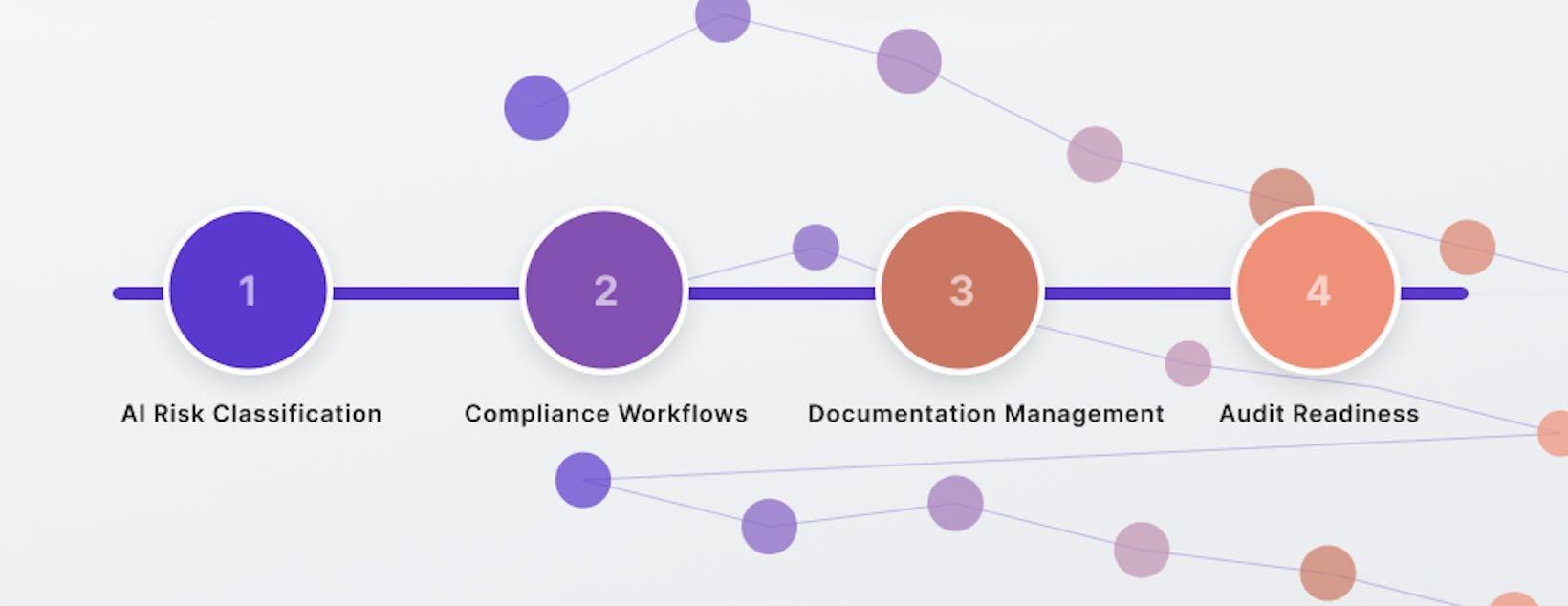
AI inventory → risk classification → risk assessment → documentation → monitoring → audit readiness
That connection is important because these activities should not operate independently.
A risk assessment should connect to the AI system being evaluated.
Documentation should reflect the system's current state.
Monitoring should produce evidence.
Governance owners should know which actions remain outstanding.
The objective is to create a continuous compliance workflow rather than a collection of disconnected documents.
Compliance Readiness Is Becoming Part of Enterprise Sales
There is another reason startups should pay down AI compliance debt early: enterprise procurement.
Large customers increasingly evaluate the governance practices of AI vendors before purchasing their technology.
For an AI startup, demonstrating compliance maturity can help answer critical procurement questions faster.
A well-governed startup can provide evidence around:
-
AI risk management
-
Data governance
-
Security
-
AI system documentation
-
Monitoring
-
Human oversight
-
Regulatory readiness
This can reduce friction during legal, security, and procurement reviews.
In other words, AI compliance is becoming a sales enablement function.
The startup that can demonstrate responsible AI governance may have an advantage over a competitor with an equally strong product but weaker compliance operations.
How AI Compliance Software Helps Startups Scale
At some point, manual compliance becomes a bottleneck.
This is where AI compliance software can help organizations manage growing governance requirements more efficiently.
Instead of maintaining disconnected spreadsheets and documents, teams can use technology to structure:
-
AI inventories
-
Risk assessments
-
Governance workflows
-
Documentation
-
Compliance evidence
-
Reviews
-
Monitoring activities
-
Audit preparation
The most valuable benefit is not simply automation.
It is visibility.
Leadership can understand the organization's AI compliance posture. Compliance teams can identify outstanding actions. Product teams can understand governance requirements. Sales teams can respond to customer requests more efficiently.
That makes compliance part of the operating model rather than an administrative burden.
A Practical Way to Reduce AI Compliance Debt
Startups do not need to solve every governance challenge simultaneously.
A practical approach is to begin with the highest-impact areas.
1. Inventory Your AI Systems
Identify every AI system used, developed, or embedded across your organization.
2. Classify Risk
Determine which systems require additional governance based on their purpose and regulatory exposure.
3. Establish Ownership
Assign clear responsibility for each AI system and its compliance activities.
4. Centralize Documentation
Keep important governance evidence accessible and connected to the relevant AI system.
5. Automate Repetitive Workflows
Use AI compliance tools to reduce manual tracking and improve consistency.
6. Monitor Continuously
Review AI systems when models, vendors, use cases, or regulations change.
7. Maintain Audit Readiness
Do not wait for an audit or customer questionnaire before collecting evidence.
These steps create a foundation for scalable AI regulatory compliance.
How AnnexOps Helps Startups Pay Down AI Compliance Debt
The challenge with AI compliance debt is that it grows quietly.
By the time a startup notices it, the organization may already have dozens of AI systems, fragmented documentation, and enterprise customers demanding evidence.
AnnexOps helps AI-driven organizations turn compliance requirements into structured operational workflows.
As an AI compliance management platform, AnnexOps supports organizations with:
Centralized AI Governance
Teams can maintain visibility into AI systems, ownership, compliance activities, and governance status.
AI Risk Management
Organizations can structure risk assessments and track AI risks across their AI portfolio.
Compliance Documentation
Teams can organize compliance evidence and documentation instead of relying on disconnected files and spreadsheets.
EU AI Act Readiness
Organizations can build repeatable workflows to prepare for EU AI Act requirements and maintain compliance activities as systems evolve.
Audit Readiness
Rather than assembling evidence at the last minute, teams can maintain governance information continuously.
Scalable AI Compliance Operations
As startups add AI systems, customers, and markets, governance processes can scale with the business instead of becoming a bottleneck.
AnnexOps is designed to function as operational infrastructure for AI governance, helping organizations turn compliance from accumulated debt into a manageable business process.
The Best Time to Pay Down AI Compliance Debt Is Before It Becomes Expensive
Technical debt becomes expensive when companies postpone it for too long.
AI compliance debt follows the same pattern.
A startup may initially save time by postponing documentation, risk assessments, monitoring, or governance workflows. But as the company grows, those shortcuts become harder to unwind.
The cost can appear as:
-
Delayed enterprise deals
-
Lengthy procurement reviews
-
Regulatory exposure
-
Emergency documentation projects
-
Unclear AI ownership
-
Increased operational workload
-
Slower product launches
The alternative is to build governance alongside AI development.
That does not mean slowing innovation.
It means creating systems that allow innovation and compliance to scale together.
Conclusion: Make Compliance an AI Growth Capability
AI startups have learned to manage technical debt because they understand that shortcuts eventually create engineering costs.
The same mindset should now apply to compliance.
AI compliance debt is becoming a new form of operational debt for companies building and deploying AI at scale.
The startups that address it early can turn compliance into an advantage.
They can respond faster to enterprise customers, maintain better visibility into AI risk, improve audit readiness, and build trust with customers operating in regulated markets.
The objective is not simply to pass an EU AI Act assessment.
It is to create an AI governance operating model that can keep pace with product development.
Learn how AnnexOps helps AI-driven companies reduce compliance complexity and prepare for the EU AI Act with clarity and confidence.

 English
 Arabic
 French
 Spanish
 Portuguese
 Deutsch
 Turkish
 Italiano
 Russian
 Romaian
 Portuguese (Brazil)
 Greek
Greek