A 5 Days Golden Triangle Tour is one of the best ways to discover the cultural, historical, and architectural highlights of North India without having to rush from one monument to another. Connecting Delhi, Agra, and Jaipur, this classic itinerary brings together the lively streets of India's capital, the extraordinary Mughal heritage of Agra, and the royal atmosphere of Rajasthan's Pink City. With five days available, travelers can explore the famous landmarks while also making room for local markets, traditional food, photography, cultural experiences, and comfortable breaks between sightseeing.
The Golden Triangle is popular because each destination offers something completely different. Delhi combines centuries of history with the energy of a modern capital. Agra is home to the Taj Mahal and other magnificent Mughal monuments. Jaipur introduces travelers to Rajput forts, palaces, astronomical architecture, colorful bazaars, and Rajasthan's distinctive traditions. Jaipur is officially described by Rajasthan Tourism as one of the three corners of the Golden Triangle, alongside Delhi and Agra, and its historic attractions include Amber Palace, City Palace, Jantar Mantar, Hawa Mahal, and Jal Mahal.
Five days give this journey a particularly attractive rhythm. Instead of squeezing Delhi, Agra, and Jaipur into an exhausting schedule, you can dedicate meaningful time to each destination. You can begin with Delhi, travel to Agra, enjoy the Taj Mahal without immediately rushing onward, and then continue to Jaipur for a deeper look at Rajasthan's royal heritage.
A three-day Golden Triangle tour is useful for travelers with extremely limited time, while four days offer a more balanced experience. Five days take the itinerary a step further by allowing travelers to slow down and experience the destinations more naturally.
You can spend enough time in Delhi to understand both Old and New Delhi, dedicate a full day to Agra's major monuments, and then explore Jaipur over two days instead of attempting to see the entire Pink City in a single afternoon.
This additional time is especially valuable for families and couples. Children can have more breaks, older travelers do not need to maintain an exhausting pace, and couples can enjoy meals and photography without constantly checking the clock.
It also gives you the flexibility to add optional experiences. Depending on your interests and schedule, you might include Fatehpur Sikri, Mehtab Bagh, a traditional cooking experience, a local market visit, or an evening cultural program.
Day 1: Explore Old and New Delhi
Your 5 Days Golden Triangle Tour begins in Delhi, India's capital and one of the country's most fascinating cities.
Delhi is not a destination that can be understood through one monument. It is a city of layers, where ancient settlements, Mughal architecture, colonial-era planning, religious landmarks, crowded bazaars, modern shopping districts, and contemporary neighborhoods exist side by side.
For a first visit, the best approach is to divide your sightseeing between Old Delhi and New Delhi.
Old Delhi provides the historic atmosphere of the Mughal capital, while New Delhi introduces the grand avenues and monumental buildings associated with India's modern capital.
A private car and local guide can make the first day much easier because Delhi's traffic and distances can make an unplanned sightseeing route unnecessarily time-consuming.
Visit the Red Fort
The Red Fort is one of the most important monuments in Old Delhi.
Built during the reign of Mughal Emperor Shah Jahan, the fort served as an imperial residence and major center of Mughal power. Its imposing red sandstone walls conceal a complex of courtyards, halls, gardens, palace structures, and decorative architectural elements.
Walking through the fort gives you a sense of how enormous the Mughal court once was. The architecture is not only defensive; inside the massive walls, the complex becomes considerably more refined, with delicate decorative details and carefully planned spaces.
A guide can explain the role of the fort during different periods and help you understand how Mughal rulers used its various halls and courtyards.
Allow enough time to explore rather than treating the Red Fort as a quick photo stop.
Discover Jama Masjid
Continue to Jama Masjid, another major landmark of Old Delhi.
The mosque's large courtyard, domes, minarets, and red sandstone architecture demonstrate the grandeur of the Mughal period. Visitors should follow current rules concerning access, photography, and appropriate clothing.
The area surrounding Jama Masjid is also important because it provides an immediate transition into the busy streets of Old Delhi.
From here, you can continue toward Chandni Chowk.
Experience Chandni Chowk
Chandni Chowk is where the historical character of Delhi becomes a living, everyday experience.
Instead of simply looking at monuments, you see merchants opening shops, families buying traditional foods, artisans selling goods, spice sellers arranging products, and shoppers moving through narrow lanes.
A short cycle-rickshaw ride can be a memorable way to experience the area.
If food interests you, this is an opportunity to sample selected Delhi specialties, although travelers should choose food outlets carefully according to their own dietary and hygiene preferences.
Do not try to cover every lane. A focused visit with a knowledgeable local guide is much more enjoyable.
See India Gate
After Old Delhi, move toward New Delhi and visit India Gate.
The monument stands in the heart of the capital and is one of India's most recognizable landmarks. Its surrounding ceremonial avenues provide a dramatic contrast with the narrow streets of Old Delhi.
You can also drive through parts of the government district, subject to current traffic and security restrictions.
The contrast between the two parts of the city is one of the reasons Delhi is such a fascinating first stop on the Golden Triangle.
Visit Humayun's Tomb
Humayun's Tomb is another important Delhi attraction.
The grand garden tomb combines red sandstone, marble details, arches, formal gardens, and a monumental dome. Its symmetrical design makes it particularly appealing to architecture enthusiasts and photographers.
The monument is also useful for understanding the evolution of Mughal architecture.
If you are planning to visit the Taj Mahal in the following days, seeing Humayun's Tomb first can provide additional context for appreciating the development of Mughal garden-tomb design.
Evening in Delhi
After sightseeing, return to your hotel and relax.
Because the next day involves travel toward Agra, avoid creating an unnecessarily late evening.
You can enjoy dinner at your hotel or visit a nearby restaurant.
The five-day itinerary works best when you treat the journey as a complete travel experience rather than trying to fill every available minute with sightseeing.
Day 2: Delhi to Agra and Agra Sightseeing
Start the second day by traveling from Delhi to Agra.
The journey can be made by private car or another suitable transportation option depending on your tour arrangement.
Arriving in Agra earlier gives you more time to explore the city's Mughal heritage.
Agra is internationally famous for the Taj Mahal, but the city has much more to offer. Agra Fort, Itmad-ud-Daulah, Mehtab Bagh, local crafts, and Mughlai cuisine can all add depth to your visit.
Explore Agra Fort
Begin with Agra Fort, one of the city's most significant historical monuments.
The massive red sandstone fort developed over several Mughal reigns and became an important imperial residence and administrative center.
Inside the defensive walls are palaces, audience halls, courtyards, mosques, gardens, and other royal structures.
The contrast between the massive exterior walls and sophisticated interior architecture is striking.
A private guide can bring the complex to life by explaining the stories of the emperors who lived there and the political events that shaped the Mughal Empire.
Visit Itmad-ud-Daulah
If time permits, visit Itmad-ud-Daulah's Tomb, often nicknamed the "Baby Taj."
The monument is smaller than the Taj Mahal but is notable for its detailed marble work and decorative inlay.
For travelers interested in architecture, this optional stop provides a useful comparison between different Mughal monuments.
It can be especially rewarding for photographers because the smaller scale allows you to focus closely on decorative details.
Visit Mehtab Bagh
Mehtab Bagh is another optional Agra attraction.
Located across the Yamuna River from the Taj Mahal, the garden provides a different perspective toward the monument.
The location can be particularly appealing around changing light, making it popular among photographers.
Because your itinerary already includes the Taj Mahal and Agra Fort, treat Mehtab Bagh as an optional addition rather than something you must visit.
Explore Agra's Marble Craft
Agra has a long tradition of decorative marble craftsmanship.
Local workshops and stores may display marble products featuring intricate inlay patterns inspired by Mughal decorative techniques.
You may find tables, boxes, decorative panels, miniature monuments, and other handcrafted products.
If you intend to purchase something, compare craftsmanship and prices before deciding.
Shopping can be a pleasant part of the trip, but it should not replace the major historical experiences.
Enjoy Agra's Cuisine
Agra is also known for its Mughlai culinary traditions.
You can try dishes influenced by the city's Mughal heritage along with North Indian vegetarian options, breads, rice dishes, sweets, and snacks.
If you have dietary restrictions, communicate them clearly when choosing a restaurant.
A good lunch can also provide a useful break between major sightseeing stops.
Day 3: Taj Mahal Sunrise and Journey to Jaipur
Day three begins with the experience most travelers have been waiting for: the Taj Mahal.
An early visit is particularly popular because the changing morning light can create beautiful conditions for photography and sightseeing.
Before your trip, confirm the monument's current visitor schedule, ticket arrangements, security rules, and weekly closure information, since access policies can change.
Experience the Taj Mahal at Sunrise
The Taj Mahal is the centerpiece of the Golden Triangle for many visitors.
Commissioned by Mughal Emperor Shah Jahan as a mausoleum for Mumtaz Mahal, the monument is celebrated for its white marble architecture, symmetrical design, gardens, decorative inlay, calligraphy, and monumental dome.
Seeing it at sunrise gives the experience an especially memorable atmosphere.
As the light changes, the marble can appear subtly different in tone. The surrounding gardens and reflecting pools add to the sense of symmetry.
Take your time.
Walk through the garden, photograph the monument from several viewpoints, and allow yourself a few moments simply to appreciate the scale and craftsmanship.
Travel Toward Jaipur
After completing your Taj Mahal visit and breakfast, begin the journey toward Jaipur.
Depending on the itinerary, Fatehpur Sikri can be included as a stop.
The historic city was developed under Mughal Emperor Akbar and contains monumental gateways, courtyards, palaces, and religious architecture.
For travelers interested in Mughal history, it can be an excellent addition.
However, it is important not to overfill the day. The purpose of a five-day itinerary is to create more breathing room, not to add every attraction available.
Arrive in Jaipur
After reaching Jaipur, check into your hotel.
Depending on your arrival time, you can take a relaxed evening walk through a suitable market area or enjoy dinner at a restaurant featuring Rajasthani cuisine.
Do not worry if you do not see many Jaipur monuments on this day.
You have two days in Jaipur, which is one of the biggest advantages of choosing a five-day itinerary.
Day 4: Royal Jaipur and Amber Fort
Day four is dedicated to the royal side of Jaipur.
Rajasthan Tourism describes Jaipur as a planned historic city founded in 1727 by Sawai Jai Singh II and highlights Amber Palace, City Palace, Jantar Mantar, Hawa Mahal, and Jal Mahal among its principal attractions.
Start with Amber Fort, then continue toward the central Pink City.
Explore Amber Fort
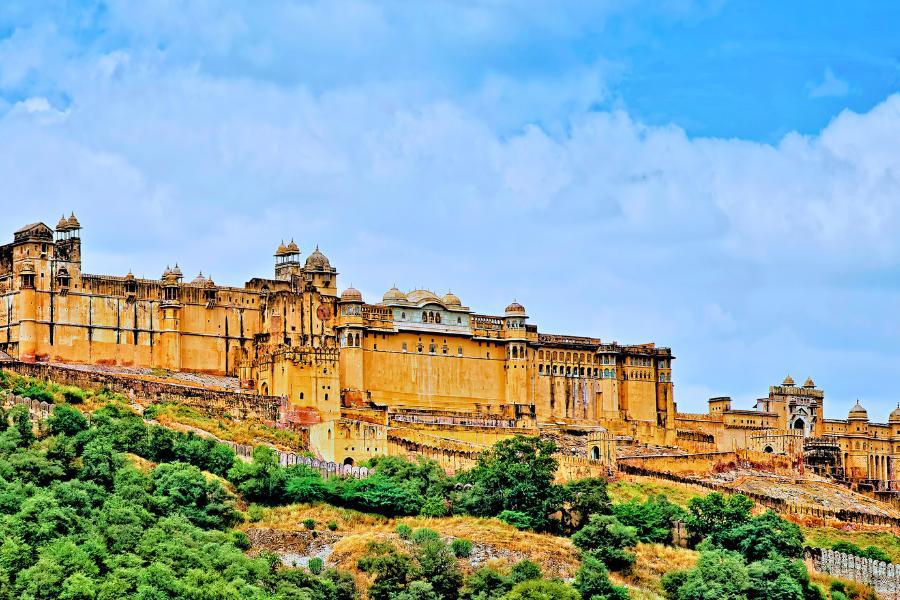
Amber Fort, also known as Amer Palace, is located about 11 kilometers from central Jaipur according to Rajasthan Tourism. The complex combines Rajput and Mughal architectural influences and contains courtyards, palace halls, temples, gardens, and decorative interiors.
The fort's hilltop setting makes the approach particularly dramatic.
Inside, you can explore the Diwan-i-Aam, royal quarters, gardens, temples, and the famous Sheesh Mahal.
The mirror work is one of the most memorable decorative features, but do not overlook the broader architecture.
The fort tells the story of Jaipur's royal past through its layout, defensive position, courtyards, and ceremonial spaces.
Stop at Jal Mahal
On your return toward Jaipur, stop at Jal Mahal.
The palace appears to float in the middle of Man Sagar Lake, creating one of the city's most recognizable landscapes. Rajasthan Tourism specifically highlights the contrast between the palace's warm stone exterior and the blue water surrounding it.
Usually, the best experience is simply enjoying the view from the lakeside and taking photographs.
Visit City Palace
Continue to City Palace, located in Jaipur's historic walled city.
The complex was conceived by Sawai Jai Singh II and combines Mughal and Rajput architectural influences. Its museums and palace buildings contain royal costumes, textiles, weapons, decorative objects, and other historical collections.
Take your time here.
The palace is not simply one building. It is a collection of courtyards, gates, galleries, residences, and museum spaces.
A guide can help explain how the different sections were used and how Jaipur's royal traditions developed.
Discover Jantar Mantar
Next, visit Jantar Mantar, the historic astronomical observatory.
Rajasthan Tourism describes it as the largest of the five astronomical observatories built by Sawai Jai Singh II and notes that its geometric instruments were designed to measure time, track celestial bodies, and observe astronomical movements.
The site is fascinating because it demonstrates another side of Jaipur's history.
The city was not built only around royal power and military defense. Astronomy, mathematics, science, and urban planning were also important parts of its intellectual heritage.
See Hawa Mahal
Finish the main sightseeing route with Hawa Mahal, the Palace of Winds.
The five-story pink sandstone structure is one of Jaipur's most recognizable landmarks. Its numerous windows and jharokhas were designed to allow royal women to observe street life while remaining largely unseen.
The best-known photograph is taken from across the road, where the entire honeycomb-like facade can be seen.
If time permits, you can also enter the building and view the city from its upper levels.
Day 5: Jaipur Markets, Culture, and Departure
The fifth day gives your 5 Days Golden Triangle Tour something that shorter itineraries often lack: flexibility.
Instead of immediately rushing toward your departure, you can use the morning for additional Jaipur experiences.
This is the perfect opportunity to explore markets, visit a museum, enjoy traditional food, or see a less crowded attraction.
Explore Jaipur's Traditional Markets
Jaipur is famous for handicrafts, textiles, jewelry, blue pottery, block printing, leather products, and traditional decorative arts.
Shopping here can be more meaningful when you understand what you are buying.
Ask about the material, production method, and craftsmanship before purchasing expensive items.
If you are looking for textiles, compare patterns and fabric quality.
If jewelry interests you, request clear information about materials and pricing.
The goal is not to buy as much as possible. It is to find something that genuinely reminds you of Rajasthan.
Visit Albert Hall Museum
If you enjoy history and art, Albert Hall Museum can be a worthwhile addition to your final day.
The museum contains collections associated with decorative arts, metal objects, sculptures, carpets, arms, textiles, and paintings.
It offers a different perspective on Rajasthan after several days of forts and palaces.
Instead of seeing another royal building from the outside, you can spend time examining objects connected with regional craftsmanship and cultural history.
Optional Nahargarh Fort
Travelers with extra time can consider Nahargarh Fort.
The fort provides elevated views over Jaipur and can be particularly attractive for photography.
However, its inclusion depends heavily on your departure schedule.
If you need to catch a flight or train, do not create unnecessary stress by adding a distant attraction at the last minute.
Enjoy a Rajasthani Lunch
Before departure, enjoy a traditional Rajasthani meal.
A Rajasthani thali allows you to sample several dishes in one sitting, from lentils and vegetables to breads, rice, sweets, and regional accompaniments.
Food is one of the easiest ways to turn a sightseeing trip into a cultural experience.
If you are vegetarian, Jaipur offers many excellent vegetarian choices.
Departure From Jaipur or Return to Delhi
Your five-day itinerary can finish in Jaipur, which is convenient if you are flying or traveling onward from the city.
Alternatively, you can arrange a private transfer back to Delhi if your international or domestic flight departs from Delhi.
The best option depends on your wider India itinerary.
If your tour operator offers one-way drop-off arrangements, confirm the final destination before booking.
5 Days Golden Triangle Tour Itinerary at a Glance
| Day |
Destination |
Main Experiences |
| Day 1 |
Delhi |
Red Fort, Jama Masjid, Chandni Chowk, India Gate, Humayun's Tomb |
| Day 2 |
Agra |
Agra Fort, Itmad-ud-Daulah, Mehtab Bagh, local crafts |
| Day 3 |
Agra → Jaipur |
Taj Mahal sunrise, optional Fatehpur Sikri, Jaipur arrival |
| Day 4 |
Jaipur |
Amber Fort, Jal Mahal, City Palace, Jantar Mantar, Hawa Mahal |
| Day 5 |
Jaipur |
Markets, Albert Hall Museum, optional Nahargarh Fort, departure |
This is a flexible framework rather than a rigid schedule. Actual sightseeing order should be adjusted according to monument schedules, weather, traffic, arrival and departure times, and your personal interests.
What Makes a 5-Day Tour Better Than a 3-Day Tour?
The biggest difference is pace.
A three-day itinerary has to prioritize only the most important attractions. Four days allow more flexibility, but five days create enough room for additional experiences without making the trip feel like a race.
You can dedicate more time to Delhi, enjoy Agra without immediately leaving after the Taj Mahal, and explore Jaipur over two days.
This is especially valuable if you enjoy photography.
Instead of arriving at a monument, taking one photograph, and immediately leaving, you can wait for better light, explore different viewpoints, and appreciate architectural details.
The same principle applies to food and shopping.
You have enough time to enjoy a local meal without watching the clock and enough time to browse a market without sacrificing a major monument.
Private Car for a 5-Day Golden Triangle Tour
A private car is one of the most convenient ways to experience the Golden Triangle.
The major advantage is flexibility.
You can begin sightseeing early, stop for refreshments, take photographs during road journeys, and adjust the schedule when necessary.
For families, private transportation makes it easier to carry luggage and manage children's needs.
For couples, it provides privacy.
For older travelers, it allows more frequent breaks.
For photographers, it means you can stop when you see an interesting landscape or village scene along the route, where practical and safe.
A good driver also understands the major roads between Delhi, Agra, and Jaipur and can help make the travel days more comfortable.
What Is Included in a 5-Day Golden Triangle Package?
Inclusions vary significantly between tour companies.
A typical private package may include transportation, driver services, accommodation, breakfast, hotel transfers, sightseeing, and private local guides.
Entrance tickets may or may not be included.
Lunch and dinner are also often handled separately depending on the package.
Always request a detailed inclusion list before paying.
| Feature |
Usually Available? |
| Private air-conditioned vehicle |
Yes |
| Professional driver |
Yes |
| Delhi hotel pickup |
Usually |
| Agra accommodation |
Package-dependent |
| Jaipur accommodation |
Package-dependent |
| Breakfast |
Often |
| Local guides |
Often included or optional |
| Monument tickets |
Package-dependent |
| Lunch and dinner |
Package-dependent |
| Airport/railway transfers |
Often available |
| Shopping |
Personal expense |
A low advertised price can sometimes exclude important expenses, so compare the complete package rather than the headline rate.
Best Time for a 5 Days Golden Triangle Tour
The cooler months are generally comfortable for sightseeing because much of the itinerary takes place outdoors.
Winter mornings can be cool, and occasional fog can affect visibility around Delhi and Agra.
The warmer months can be significantly hotter, particularly during afternoon sightseeing. Early morning starts become especially useful during this period.
The monsoon season brings rain and humidity, but it can also create greener scenery and fewer crowds at some attractions.
Regardless of when you travel, check the weather forecast shortly before departure and confirm the latest monument schedules.
What Should You Pack for the Golden Triangle?
Pack for comfort rather than fashion alone.
You will walk through large forts, palaces, gardens, markets, and historical complexes, so comfortable shoes are essential.
Your packing list should generally include:
- Comfortable walking shoes
- Lightweight clothing suitable for the season
- Sunglasses and sunscreen
- Hat or cap
- Reusable water bottle
- Small day bag
- Phone and charger
- Personal medicines
- Identification and travel documents
When visiting religious sites, modest clothing is a sensible choice.
If you enjoy photography, bring spare batteries or a power bank because you will have many opportunities to use your camera or phone.
Is a 5-Day Golden Triangle Tour Good for Families?
A five-day itinerary can be particularly suitable for families because it provides more flexibility.
Children often enjoy the dramatic architecture of forts and palaces, the stories behind the Taj Mahal, colorful markets, and the different foods available in each city.
At the same time, children can become tired during long sightseeing days.
The solution is not to eliminate sightseeing but to balance it.
Include regular breaks, choose comfortable hotels, avoid unnecessary late nights, and use private transportation whenever possible.
A five-day schedule gives you the opportunity to adjust the pace without sacrificing the major attractions.
Is It Good for Couples?
The Golden Triangle is an excellent choice for couples who want a mixture of culture, history, architecture, food, and photography.
The Taj Mahal naturally provides a memorable highlight, while Jaipur offers palace courtyards, colorful streets, rooftop dining possibilities, and spectacular architecture.
A private vehicle makes the journey more intimate and allows couples to customize their sightseeing.
The additional fifth day also means you do not have to rush through Jaipur.
You can spend time shopping, enjoying a meal, visiting a museum, or simply relaxing at your hotel.
Is a 5 Days Golden Triangle Tour Worth It?
For first-time visitors to India, yes—the five-day itinerary offers excellent variety.
You experience three major cities, multiple historical periods, different architectural styles, regional cuisines, traditional crafts, and contrasting urban environments.
The itinerary also works well as an introduction to a longer India vacation.
After experiencing Delhi, Agra, and Jaipur, you may decide to continue toward destinations such as Rajasthan's other historic cities, Ranthambore, Varanasi, or other parts of India.
The Golden Triangle gives you a foundation for understanding the country's diversity.
Tips for a Smooth Golden Triangle Journey
Start sightseeing early whenever possible.
Keep the itinerary flexible because traffic and weather can affect travel times.
Book accommodation in convenient locations rather than choosing hotels based solely on price.
Confirm monument schedules before visiting.
Use licensed or reputable guides for major monuments.
Drink enough water, particularly during warmer months.
Be selective with shopping and compare prices.
Most importantly, do not turn the trip into a race.
The purpose of five days is to experience India, not simply to collect photographs of monuments.
Conclusion
A 5 Days Golden Triangle Tour provides a wonderful balance between India's most famous monuments and the cultural experiences that make traveling through North India so memorable. Delhi introduces you to the country's capital and its fascinating mixture of Mughal, colonial, and modern influences. Agra brings the unforgettable Taj Mahal and the impressive Agra Fort. Jaipur then opens the door to Rajasthan's royal world of hill forts, palaces, astronomical architecture, colorful markets, and traditional cuisine.
The five-day format is especially appealing because it gives you time to breathe.
You can explore Delhi properly rather than rushing through it, spend meaningful time in Agra, experience the Taj Mahal in the morning, and enjoy a longer stay in Jaipur. Rajasthan Tourism's current information highlights Amber Palace, City Palace, Jantar Mantar, Hawa Mahal, and Jal Mahal among Jaipur's major attractions, making the city particularly rewarding when you have enough time to explore it.
A private car can make the journey even more comfortable, especially for families, couples, and travelers who want to customize their schedule. You can choose when to leave, where to stop, how long to spend at attractions, and whether to include optional experiences such as Fatehpur Sikri, Mehtab Bagh, local markets, or museums.
Ultimately, the 5 Days Golden Triangle Tour is not simply about seeing three famous cities. It is about experiencing the contrast between Delhi's energetic streets, Agra's Mughal grandeur, and Jaipur's royal Rajasthani character. Five days give you enough time to see the highlights while still leaving room for the small moments—an unexpected market discovery, a delicious local meal, a beautiful sunset, or a conversation with a local guide—that often become the most memorable parts of an India trip.
FAQs
1. What cities are included in a 5 Days Golden Triangle Tour?
The traditional Golden Triangle includes Delhi, Agra, and Jaipur. Delhi is generally the starting point, Agra is visited next, and Jaipur completes the main circuit.
2. Can I visit the Taj Mahal at sunrise during the tour?
Yes, provided your travel date and the monument's current visitor schedule allow it. Sunrise is a popular time to visit because the morning light can be beautiful and temperatures are generally more comfortable.
3. Can I customize a 5-day Golden Triangle itinerary?
Yes. A private itinerary can be customized according to your interests. You can add optional attractions, spend additional time shopping, choose different hotels, adjust sightseeing times, or arrange a departure from Jaipur instead of returning to Delhi.
4. Is five days enough to explore Jaipur?
Five days are enough for a Golden Triangle highlights tour that includes meaningful time in Jaipur. Two days in Jaipur can comfortably cover Amber Fort, Jal Mahal, City Palace, Jantar Mantar, Hawa Mahal, markets, and selected optional attractions without the extreme rush of a one-day visit.
5. Should I choose a private car or train for the Golden Triangle?
Both can work, but a private car provides greater flexibility between Delhi, Agra, and Jaipur. It allows direct hotel transfers, sightseeing stops, flexible departure times, and optional attractions along the route. For travelers who value convenience and customization, private transportation is often the easiest choice.




 English
 Arabic
 Spanish
 Portuguese
 Deutsch
 Turkish
 Dutch
Dutch
 Italiano
 Russian
 Romaian
 Portuguese (Brazil)
 Greek
Greek