


Reliable Fume Extractor Suppliers in India: Key Differences
Somebody on your assembly line is standing in front of a soldering station right now, breathing in whatever that iron just released. Nobody clocked it. That's the problem with solder smoke — it doesn't announce itself, it accumulates. And the moment your QC lab flags a compliance audit, "we'll sort the ventilation next quarter" stops being an option.
If you're searching for a fume extractor, you're probably past the browsing stage. You've had a near-miss, a labor inspection, or an operator complaint. That's usually what triggers the search for genuine fume extractor manufacturers in India rather than whatever showed up first on a marketplace listing.
Here's the part most buyers skip: solder fumes aren't just smoke. It's a cocktail of metal particulates — airborne pollutants like lead, tin, and various fume compounds that enter the bloodstream through skin, lungs, and mucous membranes when inhaled over time. That's not a footnote. That's the reason this equipment category exists.
SPECIFICATION
The Filtration Number That Actually Matters
Most listings lead with airflow. Ignore that first. What you want is filtration efficiency at the micron level, because a machine can move a lot of air and still push contaminated air right back at your operator.
-
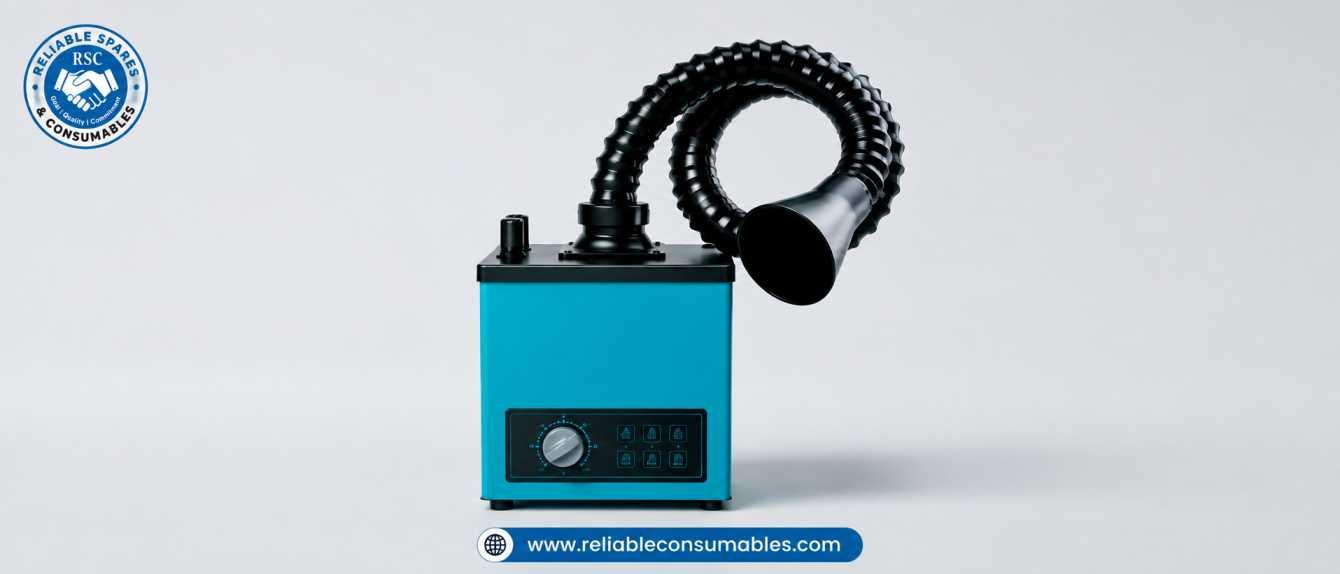
Portable / desktop units — single or dual-arm, typically rated for one to two workstations. A common desktop configuration runs around 200W, moves roughly 350m³/h, and filters particulate down to 0.3μm at 99.5% efficiency.
-
Industrial multi-operator systems — centralized ducting feeding two or more stations. Some multi-stage industrial units are built for 99.97% clean air output while operating below 60 dBA, which matters more than people assume on a floor with 40 soldering stations running back to back.
-
ESD-safe variants — grounded housings, anti-static coating, conductive extraction arms. Non-negotiable near sensitive PCB assembly.
The detail buyers overlook: filter replacement cost over three years, not the unit price. A cheap extractor with an expensive proprietary filter cartridge will cost you more by year two.
OBJECTIVE
Five things to check before you sign a PO — and what a bad answer sounds like on each.
-
Filtration certification. Bad answer: "our filters are very effective." Good answer: a specific micron rating with a test report attached.
-
After-sales filter availability. Bad answer: "we'll arrange it." That's not a supply chain, that's a promise with no date on it.
-
ESD compliance documentation. Bad answer: silence, or a vague "yes it's ESD safe" with no grounding spec.
-
Noise rating under load. Bad answer: they quote the idle number, not the running number.
-
Lead time on replacement units. Bad answer: "depends on stock." A supplier who can't commit to a week on a standard model doesn't have inventory — they have a catalog.
BENEFITS
Not features. Risk reduction.
Reliable filtration cuts respiratory-related sick leave, which protects your production schedule more than it protects your CSR report. Grounded ESD housings prevent static discharge near sensitive components, which protects your yield rate directly. Documented compliance protects you during labor and environmental audits — the ones that shut lines down for days when paperwork's missing. Lower dBA output protects operator focus across an eight-hour shift, and focus is what keeps solder joint defects low. Modular filter cartridges protect your maintenance budget from the surprise cost of proprietary replacements.
That's five. A sixth, less discussed: resale and redeployment value. Units built to recognized specs hold value when you relocate a line — generic ones don't.
AVAILABILITY
We supply across India, and location changes more than delivery time — it changes support response. A Pune-based EMS unit calling a Delhi-only supplier for a failed blower motor on a Friday afternoon is not getting same-day support. That's a Monday problem now, and Monday problems on a production floor compound fast.
Our dispatch network covers major electronics manufacturing clusters — Bengaluru, Pune, Chennai, the NCR belt — with regional stocking that shortens replacement-part turnaround. If you're evaluating fume extractor suppliers in India, ask where their nearest service point actually sits relative to your facility, not their head office.
ABOUT US
We've been supplying ESD products and industrial electronics tools to manufacturing floors across India since 2013. We didn't start as a fume extraction specialist — we built into it because our existing PCB assembly clients kept asking who we'd recommend, and most answers in the market were resellers with no service backup.
One thing we changed: we stopped stocking a particular carbon filter cartridge in 2022 after two repeat clients in Gujarat reported saturation faster than the rated lifespan under high-volume soldering. We switched suppliers on that component within a month. That's the kind of adjustment you only make when clients are calling you directly, not routing complaints through a support ticket queue.
Take Action
Send us your floor layout, number of soldering stations, and whether you need ESD-rated units — we'll respond within 24 hours with a spec-matched recommendation and pricing. Minimum order quantity starts at one unit for evaluation; volume pricing kicks in from five units onward. Reach us through the contact form on our site or call directly — we don't route first inquiries through a chatbot.
CONCLUSION
A fume extractor isn't a compliance checkbox — it's the difference between an operator who lasts ten years on your floor and one who's out on medical leave in year three. Pick the fume extractor manufacturers who can answer the five questions above without hedging. That's usually the same one who'll still take your call after the invoice clears.
FAQs
1. What's the difference between a fume extractor and a smoke absorber?
Mostly marketing. Same core function — capturing airborne particulates at the source. What actually differs is filtration efficiency and whether it's ESD-rated. Don't pick based on the name.
2. Do I need ESD-safe fume extractor manufacturers specifically, or will a standard unit work?
If you're near sensitive components or bare boards, yes — a non-grounded unit is a genuine static risk. If it's general rework or repair bench work, a standard unit is usually fine. Ask before assuming.
3. How often do filters need replacing?
Depends entirely on volume. A single-operator desk unit might run three to four months; a high-volume industrial line could need monthly changes. Any supplier who gives you one number for every scenario hasn't asked about your workload.
4. Are Indian-made units as reliable as imported brands?
Honestly — it varies. Some domestic fume extractor dealers in India carry units built to genuinely solid specs. Others cut corners on motor life to hit a price point. Check the warranty terms, not the country of origin.
5. What's a realistic lead time from fume extractor dealers?
Stocked standard models: usually 3–7 days. Custom ducted industrial systems: 3–5 weeks depending on configuration. Anyone promising next-day on a custom multi-station system is not being straight with you.

 English
 Arabic
 French
 Spanish
 Portuguese
 Deutsch
 Turkish
 Italiano
 Russian
 Romaian
 Portuguese (Brazil)
 Greek
Greek