


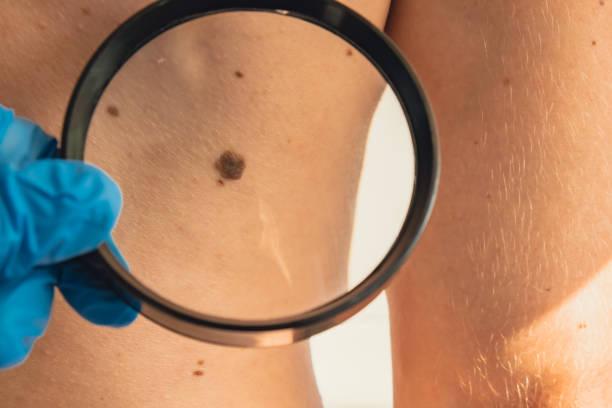
While many moles are harmless and can be left alone, there are specific circumstances in which a doctor will strongly recommend removal. For those considering Mole Removal in Riyadh, understanding when removal is medically necessary is essential for protecting your health and ensuring timely intervention. Mole Removal in Riyadh outlines the key situations where medical professionals advise removal, ensuring you have the knowledge to make informed decisions about your skin.
The ABCDE Rule: When a Mole Raises Red Flags
The most common reason a doctor recommends removal is the suspicion of skin cancer. Dermatologists use the well-established ABCDE rule as a primary screening tool for concerning moles.
A – Asymmetry
If one half of the mole does not match the other, it is a reason for concern . This asymmetry suggests the mole may be growing abnormally.
B – Border Irregularity
A benign mole typically has smooth, clearly defined edges. If the borders are irregular, ragged, or blurred, this warrants professional evaluation and likely removal with biopsy.
C – Color Variation
A mole that contains multiple colors—such as shades of tan, brown, black, blue, white, or red—is suspicious . A mole that is very dark, especially when new, can also be a warning sign.
D – Diameter
While melanomas can be smaller, a mole larger than approximately 6 mm (the size of a pencil eraser) is a reason for removal . Larger moles, particularly those that have changed over time, require assessment.
E – Evolving
Evolution is the most critical sign. Any change in a mole's size, shape, color, or symptoms like itching, crusting, or bleeding requires prompt removal . The "ugly duckling" sign—a mole that looks different from all the others on your body—also warrants removal.
Moles with Persistent Symptoms
A mole that is painful, itching, crusting, or bleeding should be evaluated by a dermatologist, even if it does not show the ABCDE signs . These symptoms can be indicators of skin cancer and, at the very least, suggest irritation that may require removal for comfort and diagnostic purposes.
New Moles After Age 30
While new moles can appear in childhood and young adulthood, the appearance of a new mole after the age of 30 is a reason for a dermatological evaluation . In adults, new moles are less common and may be a sign of developing skin changes, including melanoma.
Moles in High-Friction Areas
Moles located in areas of constant friction—such as under a bra strap, on the waistline, or on the neck where a collar rubs—can become irritated and problematic . While they may be benign, the chronic irritation can lead to discomfort and, in some cases, obscure changes that are important for monitoring. If a mole is frequently irritated, your doctor may recommend removal to alleviate discomfort and ensure the mole is not changing.
Personal or Family History of Skin Cancer
If you have a personal or family history of skin cancer, you are at a higher risk of developing melanoma . In these cases, dermatologists may recommend a more proactive approach to monitoring and removing suspicious moles. Even if a mole appears benign, your doctor may recommend removal for biopsy to provide definitive peace of mind.
The "Ugly Duckling" Sign
If a mole looks significantly different from all the other moles on your body, it should be evaluated . This sign is particularly important because most melanomas arise on normal-looking skin rather than from existing moles. A mole that stands out as "ugly" compared to others often warrants removal.
What Happens After Medically Recommended Removal?
The Biopsy Process
When a mole is removed for medical reasons, it is sent to a pathology lab for histological analysis . The results will tell you definitively whether the mole was benign, precancerous (dysplastic), or malignant (cancerous). This step is essential for your long-term health.
If the Mole Is Cancerous
If the biopsy confirms melanoma or another skin cancer, your dermatologist will discuss further treatment options, which may include a wider excision, additional imaging, or consultation with an oncologist. Early detection through removal dramatically improves outcomes.
If the Mole Is Benign
If the biopsy confirms the mole is benign, no further treatment is necessary, and the wound is left to heal. This result provides peace of mind and closes the chapter on that particular mole.
For those seeking expert guidance and customized aesthetic care, you can book an appointment consultation at the Enfield Royal Clinic.
Frequently Asked Questions
What are the first signs that a mole may be dangerous?
The first signs include asymmetry, irregular borders, color variation, diameter over 6mm, or any evolution in size, shape, or color.
Is it painful to have a mole removed for medical reasons?
The area is numbed with local anesthetic, so you feel no pain during removal, only pressure or a light sensation.
How long does it take to get biopsy results?
Most biopsy results are available within 5 to 7 working days; your doctor will discuss the results at a follow-up appointment.
Why do doctors remove moles even if they look benign?
Doctors may remove benign moles if they are frequently irritated, located in high-friction areas, or if a patient has a history of skin cancer.
Can a mole grow back after medically recommended removal?
If the entire mole is surgically excised, it typically does not grow back. Shave removal carries a small risk of regrowth.

 Arabic
 French
 Spanish
 Portuguese
 Deutsch
 Turkish
 Dutch
Dutch
 Italiano
 Russian
 Romaian
 Portuguese (Brazil)
 Greek
Greek