


VAS Spectrometers – Best Metal Testing Equipment Manufacturer for Accurate Metal Analysis
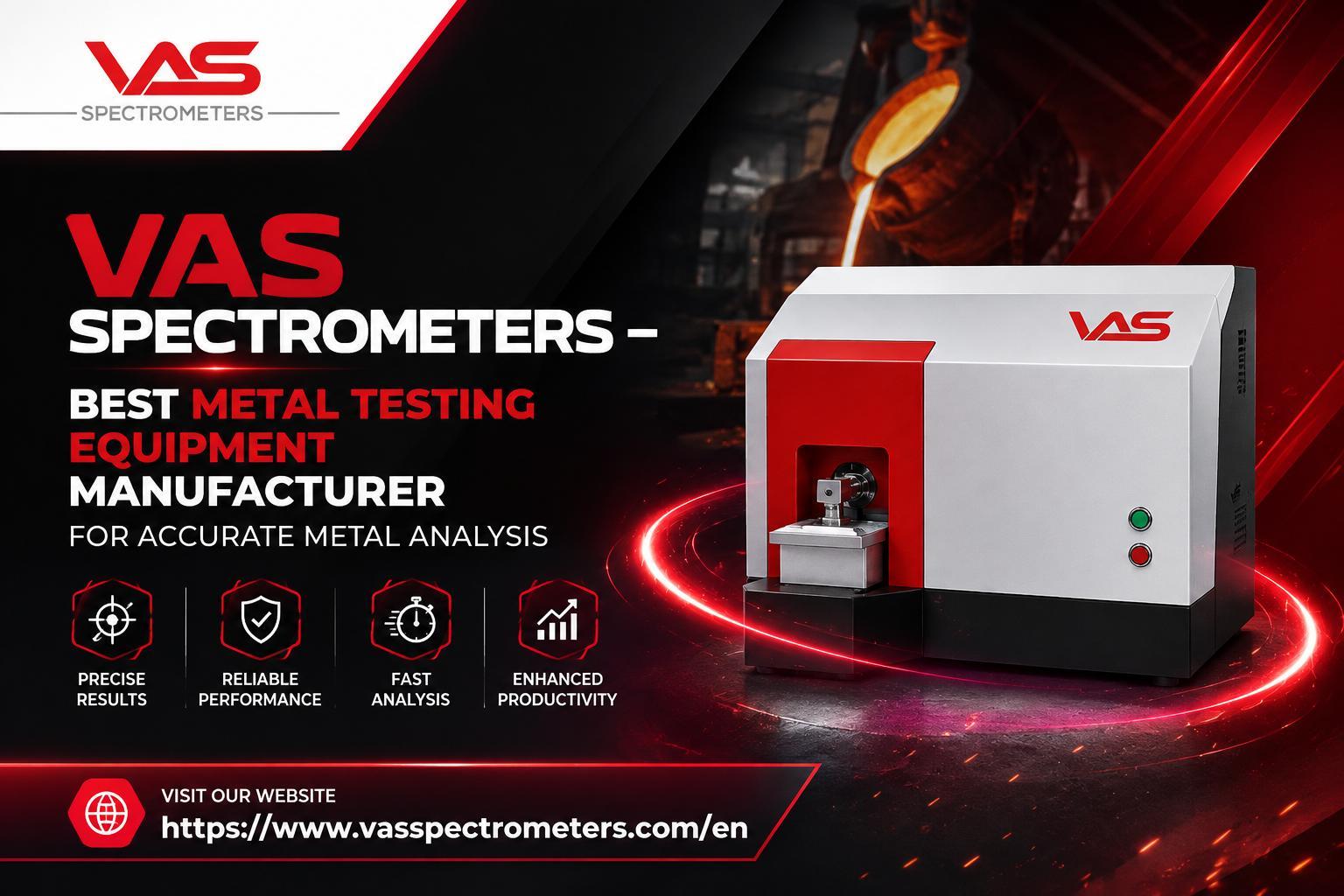
If you've spent any time around foundries, scrap yards, machining shops, or quality control labs, you already know that guessing at metal composition is a fast way to lose money — or worse, ship a defective part. Whether you're sorting alloys on an incoming dock or verifying a heat treatment batch before it goes out the door, the equipment you use to test metal determines how confident you can be in the answer you get. That's exactly why so many procurement managers, lab technicians, and plant owners eventually land on the same question: who actually makes reliable, accurate, and affordable testing instruments? For a growing number of Indian manufacturers, exporters, and scrap recyclers, the answer is VAS Spectrometers.
In this post, we'll walk through what makes VAS Spectrometers stand out as a Best Metal Testing Equipment manufacturer, how their instruments work, who should be using them, and what to look for when you're comparing metal analysis equipment for your own operation.
Why Metal Testing Accuracy Actually Matters
Before we get into the equipment itself, it's worth stepping back and asking why this even matters so much. Metal composition isn't just a technical detail — it's the foundation of everything downstream. A steel batch with the wrong carbon content can fail under stress. An aluminum alloy mixed up with a lookalike grade can crack during machining. A scrap yard that misjudges nickel or chromium content can lose serious money on every transaction.
Traditional wet chemical analysis works, but it's slow, requires trained chemists, and isn't practical when you need answers in seconds rather than hours. That's where modern spectrometers come in — they give you lab-grade accuracy without the wait, which is a big reason demand for dependable testing instruments has grown so much across foundries, rolling mills, automotive suppliers, and recycling centers.
Who Is VAS Spectrometers?
VAS Spectrometers is an Indian manufacturer that designs, builds, and services metal analysis instruments, with a particular focus on Optical Emission Spectrometers (OES) and related testing equipment used for elemental analysis of ferrous and non-ferrous metals. Rather than importing rebadged instruments and calling it a day, the company has built a name for itself by engineering equipment specifically suited to the demands of Indian foundries, steel plants, and metal trading businesses — environments that are often dustier, hotter, and more voltage-inconsistent than a typical European lab.
That distinction matters more than it sounds. A spectrometer built for a climate-controlled German lab doesn't always hold up well on an Indian shop floor with fluctuating power and heavy argon gas usage. VAS Spectrometers has leaned into solving for those real-world conditions, which is a big part of why they've earned a reputation as a Best Metal Testing Equipment manufacturer among businesses that need equipment that just keeps working, day after day.
What Makes VAS Spectrometers Stand Out
1. Purpose-Built Optical Emission Spectrometers
At the core of the VAS product line is the OES spectrometer — the industry workhorse for analyzing ferrous metals like carbon steel, alloy steel, and cast iron, as well as non-ferrous metals like aluminum, copper, and zinc-based alloys. These instruments use spark excitation to vaporize a small sample of metal and read the light emitted to determine exact elemental composition, often down to fractions of a percent.
What sets a well-built unit apart isn't just the spark stand — it's the optics, the CCD or PMT detection system, the software that interprets the readings, and the calibration stability over months of daily use. VAS has focused engineering effort on all of these, which is why their machines tend to hold calibration longer and need fewer recalibration cycles than budget alternatives.
2. Instruments Designed for Indian Industrial Conditions
● Voltage fluctuation tolerance — built to handle inconsistent industrial power without constant recalibration
● Dust and particulate resistance for foundry-floor environments
● Lower argon gas consumption, which directly reduces running costs over time
● Simplified maintenance that doesn't always require a specialized technician on standby
These aren't flashy features you'll see on a spec sheet headline, but they're exactly the details that determine whether a machine is still delivering accurate readings two years after installation — not just in the first month.
3. Strong After-Sales Support and Local Service
This is where a lot of imported equipment falls short. If your spectrometer goes down and the nearest service engineer is a flight away, you could be looking at days or weeks of downtime. VAS Spectrometers operates with a service network built around the Indian market, so support, calibration checks, spare parts, and troubleshooting don't require the same wait times as dealing with an overseas supplier. For a production environment where every hour of downtime has a real cost, that responsiveness alone can justify the choice.
4. A Range That Fits Different Business Sizes
Not every buyer needs the same machine. A small casting unit verifying incoming scrap has very different needs than a large steel plant running continuous quality checks on every heat. VAS offers a range of models covering different budgets, sample throughput requirements, and element detection ranges, so smaller operations aren't forced to overpay for capability they don't need, while larger plants can scale up to instruments built for high-volume, high-precision work.
5. Software That Doesn't Require a PhD to Operate
A spectrometer is only as useful as the interface reporting the results. VAS has put real effort into making their analysis software intuitive, with clear pass/fail grading against standard specifications, easy report generation, and straightforward calibration workflows. This matters a lot in practice — the best hardware in the world doesn't help if your operator needs an engineering degree to pull a usable report.
Who Should Be Using This Equipment?
Metal testing instruments from a manufacturer like VAS Spectrometers are relevant across a wider range of businesses than people often expect:
● Foundries and casting units verifying alloy composition before and after melting
● Steel and rolling mills confirming grade compliance for outgoing products
● Scrap metal recyclers and traders sorting and pricing material accurately
● Automotive and aerospace component manufacturers maintaining strict material certifications
● Fabrication and machining shops confirming incoming raw material matches the purchase order
● Quality control and testing labs offering third-party material verification services
If your business depends on knowing exactly what a piece of metal is made of — rather than trusting a mill certificate or a supplier's word — this category of equipment isn't a luxury. It's a basic form of risk management.
What to Look for When Comparing Metal Testing Equipment
If you're currently shopping around, here are a few things worth checking regardless of which manufacturer you're considering:
● Detection range and accuracy — make sure the instrument covers the specific elements and concentration ranges relevant to your materials
● Calibration stability — ask how often recalibration is needed under normal daily use
● Running costs — argon consumption, electrode replacement, and consumables add up over a year
● Local support and spare parts availability — downtime is expensive, so service turnaround matters
● Software usability — your operators should be able to run tests confidently without extensive retraining
● Total cost of ownership — not just the purchase price, but the multi-year cost of maintenance, consumables, and support
When you weigh all of these together — accuracy, durability under real shop-floor conditions, cost of ownership, and how quickly you can get help when something goes wrong — it becomes clear why so many buyers researching a Best Metal Testing Equipment manufacturer keep coming back to VAS Spectrometers rather than settling for a cheaper, less supported alternative.
A Quick Word on Return on Investment
It's tempting to look at spectrometer pricing and focus purely on the upfront number. But the real return on investment shows up in what you avoid: rejected batches, mismatched alloys shipped to a customer, scrap purchased at the wrong price because composition was misjudged, or a compliance failure that costs a contract. A dependable testing instrument pays for itself the first time it catches a problem that would otherwise have gone unnoticed until it was expensive to fix.
That's really the underlying case for investing in quality equipment from an established manufacturer rather than the cheapest unit available. Reliable metal analysis isn't really an expense — it's insurance against far bigger costs down the line.
Final Thoughts
Choosing testing equipment isn't a decision you want to make on price alone, and it isn't one you want to leave until after a costly mistake either. Between purpose-built OES instruments, equipment engineered for real industrial conditions, responsive local support, and a product range that fits businesses of different sizes, VAS Spectrometers has built a strong case for itself among companies looking for dependable, accurate metal analysis technology.
If accuracy, uptime, and long-term reliability matter to your operation — and for most metal-handling businesses, they do — it's worth taking a closer look at what VAS Spectrometers has to offer before making your next equipment decision.

 English
 French
 Spanish
 Portuguese
 Deutsch
 Turkish
 Dutch
Dutch
 Italiano
 Russian
 Romaian
 Portuguese (Brazil)
 Greek
Greek