


What Role Does UV Disinfection Play in Infection Control?
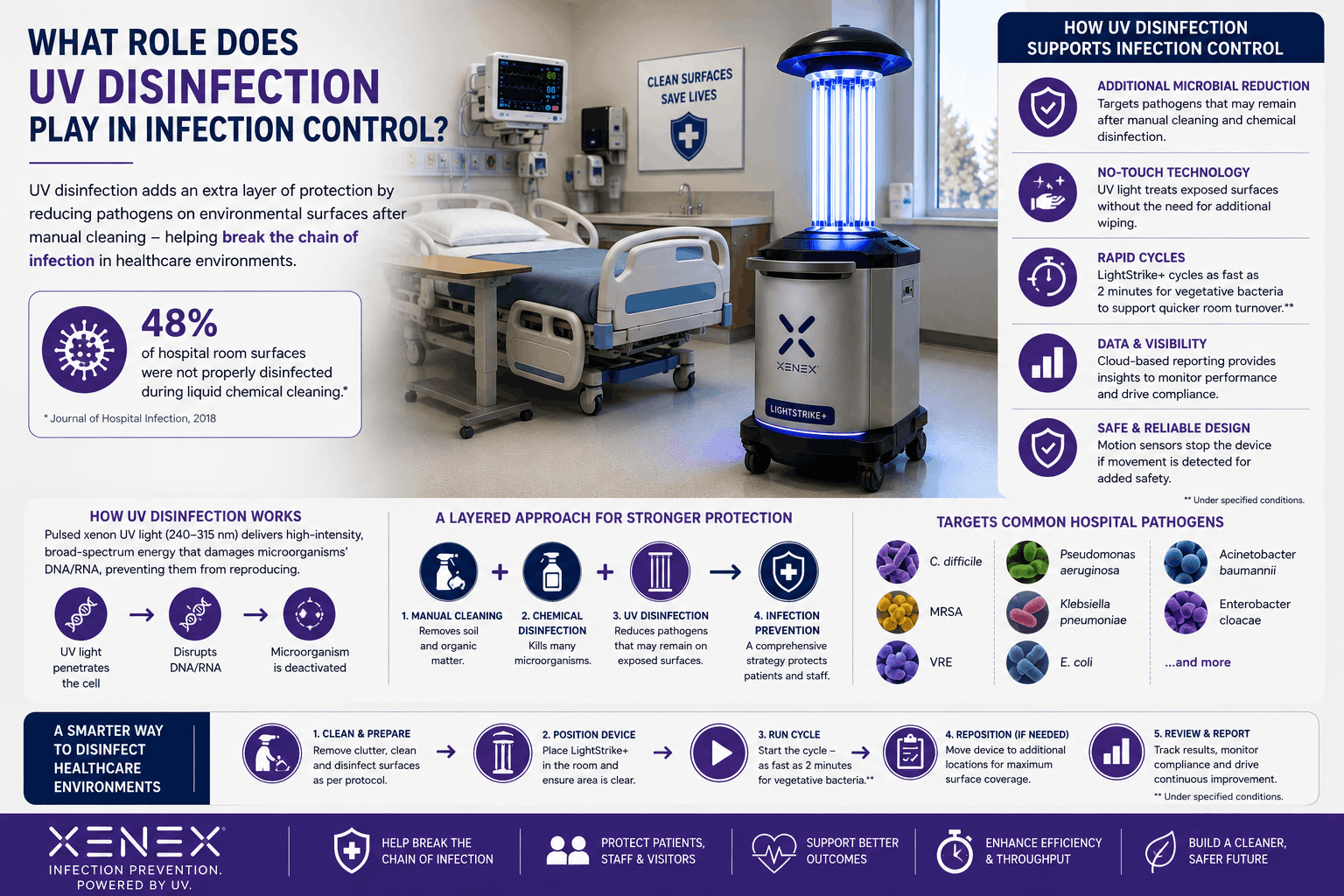
UV disinfection has become an important additional layer in modern healthcare infection prevention programs. While manual cleaning and chemical disinfection remain essential, hospital UV disinfection technology can help reduce pathogens that may remain on environmental surfaces after routine cleaning. Xenex's LightStrike+ uses high-intensity, broad-spectrum pulsed xenon UV technology as part of a whole-room microbial reduction approach.
What Is the Role of UV Disinfection in Infection Control?
Infection control involves multiple strategies designed to reduce opportunities for pathogens to spread within healthcare environments. These strategies can include hand hygiene, personal protective equipment, isolation precautions, environmental cleaning, chemical disinfection, and appropriate sterilization procedures.
UV disinfection supports this broader strategy by targeting microorganisms on exposed environmental surfaces.
Rather than replacing established cleaning procedures, UV technology can provide an additional microbial reduction step. Xenex describes LightStrike+ as a technology designed to reduce pathogens that survive liquid chemical cleaning.
This is particularly relevant in patient rooms, operating areas, isolation rooms, intensive care environments, and other spaces where high-touch surfaces can become contaminated.
Why Is Environmental Disinfection Important?
Hospital surfaces can become contaminated through contact with patients, healthcare workers, visitors, equipment, and other environmental sources.
Frequently touched surfaces may include:
-
Bed rails
-
Overbed tables
-
Door handles
-
Call buttons
-
Medical equipment controls
-
Remote controls
-
Telephone receivers
-
Bathroom fixtures
-
Workstations
-
Light switches
Even when a room looks clean, microorganisms can remain on surfaces that were missed or inadequately disinfected.
Xenex cites research indicating that 48% of hospital room surfaces were not properly disinfected during liquid chemical cleaning, demonstrating one of the challenges healthcare facilities face when relying on manual cleaning alone.
How Does UV Light Reduce Microorganisms?
Ultraviolet light is a form of electromagnetic energy. UV-C wavelengths can damage microbial genetic material, interfering with the ability of microorganisms to reproduce.
Xenex's LightStrike+ uses pulsed xenon UV technology to produce intense, broad-spectrum germicidal UV light. The company states that LightStrike+ operates across approximately 240–315 nm and is designed to target pathogens at wavelengths where they are susceptible.
The technology therefore provides a different mechanism of microbial reduction than liquid chemical disinfectants.
The effectiveness of UV exposure depends on factors such as:
-
UV wavelength
-
Intensity
-
Exposure time
-
Distance
-
Surface exposure
-
Microorganism type
-
Room configuration
-
Shadows and obstructions
How Does UV Disinfection Complement Manual Cleaning?
UV technology works best as part of a layered infection control strategy.
Manual cleaning remains important because it removes dirt, organic material, and physical contamination. Chemical disinfectants can then be applied according to the facility's established procedures.
After those steps, UV technology can provide another layer of microbial reduction on exposed surfaces.
Xenex specifically describes its approach as supplementing liquid chemical cleaning with LightStrike+ UV technology.
This means the workflow is not:
Manual cleaning OR UV disinfection
Instead, it is:
Manual cleaning + chemical disinfection + UV microbial reduction
That combination can help healthcare facilities address different environmental cleaning challenges.
What Is Pulsed Xenon UV?
There are different types of UV disinfection technologies. Xenex's LightStrike+ uses a pulsed xenon lamp rather than a conventional narrow-spectrum mercury UV bulb.
According to Xenex, LightStrike+ generates broad-spectrum UV light from approximately 240–315 nm. The company says this broad-spectrum approach provides multiple mechanisms for deactivating pathogens, compared with narrow-spectrum UV systems that primarily rely on one wavelength.
The high-intensity pulses are also designed to support rapid microbial reduction.
Xenex reports that LightStrike+ cycles can be as short as two minutes for vegetative bacteria under specified conditions.
Can UV Disinfection Reduce Hospital Pathogens?
UV disinfection is designed to reduce microorganisms on exposed surfaces, including pathogens that may contribute to healthcare-associated infection risks.
Xenex identifies organisms such as MRSA, Clostridioides difficile, VRE, Pseudomonas aeruginosa, Klebsiella pneumoniae, Escherichia coli, Acinetobacter baumannii, and Enterobacter cloacae among microorganisms evaluated with its technology.
The required exposure can differ depending on the microorganism. Spore-forming organisms, for example, may require different treatment conditions from vegetative bacteria.
Therefore, hospitals should follow validated protocols rather than assuming that one UV cycle provides identical results against every pathogen.
Why Is UV Positioning Important?
One of the most important considerations with UV disinfection is line of sight.
UV light needs to reach the surface being treated. Beds, furniture, medical equipment, walls, and other objects can create shadows that limit UV exposure.
Xenex explains that surfaces vary in their ability to reflect UV light and recommends multiple treatment positions. Its LightStrike+ best-practice approach includes a cycle on each side of a patient bed and a bathroom cycle when applicable.
High-touch objects such as phone receivers may also need to be repositioned or flipped so that different surfaces receive adequate exposure.
This means effective UV disinfection requires both the right technology and the right workflow.
Does UV Disinfection Replace Infection Prevention Practices?
No.
UV disinfection should be viewed as one component of a comprehensive infection prevention program.
Hospitals still need to maintain:
-
Hand hygiene
-
Appropriate PPE use
-
Manual environmental cleaning
-
Chemical disinfection
-
Isolation precautions
-
Equipment cleaning
-
Staff training
-
Infection prevention monitoring
-
Appropriate patient-care protocols
UV technology addresses environmental microbial reduction. It cannot replace infection prevention practices that address other routes of pathogen transmission.
Xenex states that it works with infection control teams to develop implementation processes and provides training, support, and monitoring reports.
How Does UV Technology Support Environmental Services Teams?
Environmental Services (EVS) professionals are responsible for much of the routine cleaning and disinfection performed throughout healthcare facilities.
UV technology can support these teams by adding a standardized no-touch microbial reduction step after conventional cleaning.
LightStrike+ includes features such as customizable room positioning, motion sensors that stop the device when movement is detected, and cloud-based reporting of key metrics.
These features can help integrate UV technology into established hospital workflows.
Xenex also describes implementation and workflow support designed to help healthcare facilities incorporate microbial reduction into their existing programs.
Can UV Disinfection Improve Room Turnover?
Speed is another consideration for healthcare facilities.
Hospitals need to clean and prepare rooms efficiently, especially when patient demand is high. Longer disinfection procedures can create workflow challenges.
Xenex reports that LightStrike+ cycles for vegetative bacteria can be as short as two minutes. The company links these rapid cycles to quicker room turnover and greater throughput.
However, hospitals should not interpret this as meaning that every room requires only two minutes of total UV treatment. The required cycle depends on the microorganism, room configuration, treatment positions, and validated protocol.
What Are the Benefits of Adding UV to Infection Control?
When properly integrated, UV technology can provide several potential benefits:
Additional Microbial Reduction
UV provides another mechanism for reducing pathogens that may remain after conventional cleaning.
No-Touch Treatment
Once the room is prepared and the device is correctly positioned, UV treatment does not require staff to manually wipe every exposed surface again.
Rapid Cycles
Xenex reports cycles as short as two minutes for vegetative bacteria with LightStrike+.
Standardized Workflow
Validated positioning and operating procedures can help make the additional disinfection step more consistent.
Monitoring and Reporting
LightStrike+ includes cloud-based reporting capabilities that can provide visibility into key disinfection metrics.
Why Is a Layered Infection Control Strategy Important?
No single infection prevention method can address every possible route of pathogen transmission.
A strong healthcare environmental program can combine:
-
Manual cleaning
-
Chemical disinfection
-
UV microbial reduction
-
Proper UV positioning
-
Staff training
-
Infection prevention oversight
-
Monitoring and reporting
This layered approach recognizes the strengths and limitations of each method.
For Xenex, the goal is to help healthcare facilities break the chain of pathogen transmission through evidence-based microbial reduction and integrated workflows.
Final Thoughts
So, what role does UV disinfection play in infection control? UV technology provides an additional environmental microbial reduction step that can complement manual cleaning and chemical disinfection.
Xenex's LightStrike+ uses high-intensity, broad-spectrum pulsed xenon UV technology designed for healthcare environments. The company reports rapid cycles for vegetative bacteria, while its workflow emphasizes appropriate positioning and integration with existing environmental services practices.
The most effective use of UV disinfection is not as a replacement for traditional infection prevention. Instead, it can strengthen a comprehensive program by providing another method of reducing pathogens on exposed environmental surfaces.
For healthcare facilities focused on infection prevention, environmental cleaning, microbial reduction, and patient safety, UV technology can be a valuable addition when implemented according to validated procedures and manufacturer guidance.
FAQs
1. What role does UV disinfection play in infection control?
UV disinfection provides an additional microbial reduction step for exposed environmental surfaces. It is generally used alongside manual cleaning and chemical disinfection rather than replacing them.
2. Can UV disinfection replace manual hospital cleaning?
No. Manual cleaning remains essential for removing soil, organic material, and contamination. Xenex positions LightStrike+ as a supplement to liquid chemical cleaning.
3. How quickly can pulsed xenon UV reduce microorganisms?
Xenex reports that LightStrike+ cycles can be as short as two minutes for vegetative bacteria under specified conditions. Actual treatment requirements depend on the organism and validated protocol.
4. Can UV disinfect every surface in a hospital room?
No. UV is a line-of-sight technology, so furniture and equipment can create shadows. Proper positioning and multiple treatment locations may be required to improve surface exposure.
5. Is Xenex LightStrike+ designed specifically for healthcare?
Yes. Xenex describes LightStrike+ as an FDA-authorized medical device for healthcare use, with features including high-intensity UV, customizable positioning, motion detection, and cloud-based reporting.

 English
 Arabic
 French
 Spanish
 Portuguese
 Deutsch
 Turkish
 Italiano
 Russian
 Romaian
 Portuguese (Brazil)
 Greek
Greek