


Healthcare Data Entry Services: Improving Accuracy, Efficiency and Data Management
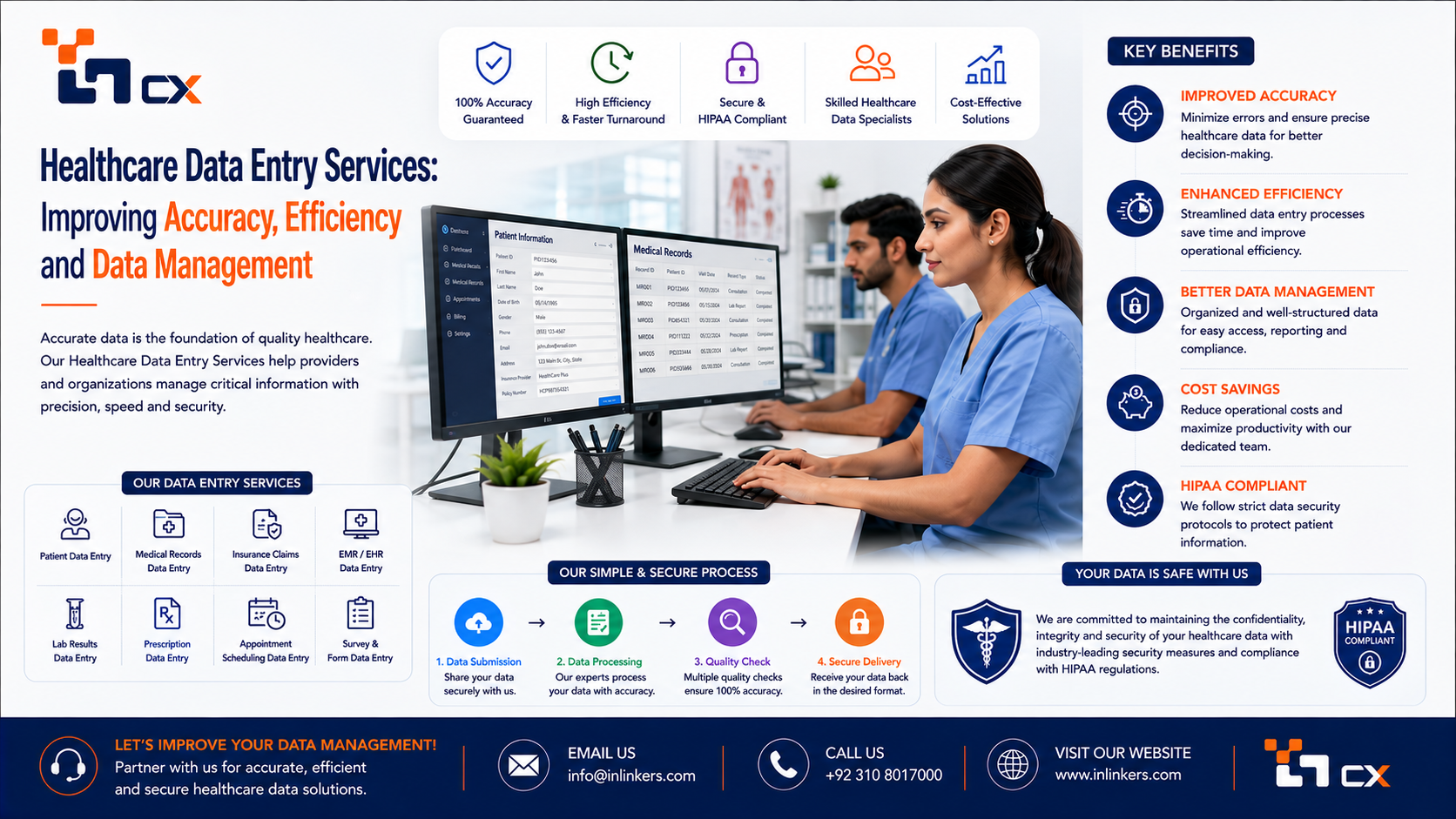
Healthcare organizations manage enormous volumes of information every day. Patient registration forms, medical records, insurance documents, laboratory reports, claims, prescriptions, invoices and electronic health records all require accurate data handling. As healthcare providers grow, managing these records internally can become time-consuming, expensive and difficult to scale.
This is why many hospitals, clinics, physician groups, medical billing companies and healthcare organizations are exploring specialized healthcare data entry outsourcing. By working with an experienced provider, healthcare businesses can transfer repetitive administrative workloads to trained professionals while allowing their internal teams to focus on patient care and higher-value responsibilities.
InLinkers CX provides healthcare BPO and data management solutions from Pakistan, supporting international organizations with data entry, medical billing, medical coding, revenue cycle management and other healthcare back-office functions.
What Are Healthcare Data Entry Services?
A healthcare data entry involves the accurate collection, organization, verification and input of healthcare-related information into digital systems.
The information may come from:
-
Patient registration forms
-
Medical records
-
Insurance documents
-
Claims
-
Laboratory reports
-
Physician notes
-
Prescription records
-
Billing documents
-
EHR systems
-
Scanned documents
-
Digital forms
-
Referral records
The objective is to convert information into an organized digital format that healthcare professionals and administrative teams can easily access and use.
Healthcare data entry is different from general data entry because the information being processed can be sensitive and may require industry-specific knowledge, strict confidentiality and carefully controlled access.
Why Healthcare Data Entry Matters
Accurate healthcare data is essential for efficient healthcare operations.
An incorrectly entered patient identifier, insurance number, billing detail, or medical record can create downstream problems. Errors can affect administrative workflows, reporting, billing processes, claims management and patient records.
Professional data entry teams can establish structured procedures for:
-
Data verification
-
Duplicate checking
-
Formatting
-
Record updates
-
Quality assurance
-
Document classification
-
Data validation
This creates a more reliable information-management process.
Healthcare Data Entry Service for Modern Healthcare Organizations
A professional healthcare data entry service can support organizations that have large volumes of information but limited internal administrative capacity.
Instead of requiring nurses, medical office employees, or administrative staff to spend significant amounts of time entering repetitive information, businesses can assign these tasks to trained data specialists.
Common activities include:
Patient Data Entry
Patient demographic information can be entered and updated in appropriate healthcare systems.
Medical Record Data Entry
Relevant information from paper or digital documents can be transferred into structured systems.
Insurance Data Entry
Insurance information, policy details and related documentation can be processed according to established workflows.
Claims Data Entry
Claims-related information can be entered, reviewed and prepared for subsequent processing.
EHR Data Entry
Healthcare information can be entered into electronic health record systems according to client-specific procedures.
Form Processing
Information from healthcare forms can be captured, categorized and entered into databases or software platforms.
Healthcare Data Entry and EHR Systems
Electronic health records have transformed healthcare administration by making patient information easier to store and retrieve.
However, organizations still need professionals to manage information entering these systems.
Data-entry specialists may work with EHR and practice-management platforms according to client requirements.
The objective is to ensure that information is:
-
Entered accurately
-
Properly categorized
-
Updated consistently
-
Accessible to authorized users
-
Protected from unauthorized access
A provider should receive appropriate system training before accessing a client's healthcare environment.
Healthcare Data Entry Outsourcing to Pakistan
Pakistan has a growing outsourcing industry supporting international organizations across healthcare, IT, customer support, finance, insurance and data management.
For international healthcare organizations, outsourcing healthcare data entry to Pakistan can provide access to trained professionals while potentially reducing operational costs.
InLinkers CX describes itself as a Pakistan-based BPO company with healthcare professionals supporting functions such as medical billing, medical coding, revenue cycle management and other healthcare back-office operations.
Outsourcing can also provide scalability when healthcare organizations experience seasonal increases or growing administrative workloads.
Cost Efficiency
Healthcare organizations often have significant administrative expenses.
Hiring and maintaining a large internal data-entry department involves:
-
Recruitment
-
Salaries
-
Employee benefits
-
Training
-
Office infrastructure
-
Software
-
Management
-
Quality assurance
An outsourced model can consolidate many of these operational requirements into a structured service arrangement.
InLinkers CX promotes its Pakistan-based outsourcing model as a way to reduce administrative costs while providing access to trained professionals.
Actual savings depend on workload, complexity, team size, working hours, technology and service requirements.
Businesses should evaluate the total cost and expected quality rather than selecting a provider based only on price.
Accuracy and Quality Assurance
Accuracy is one of the most important factors when selecting a healthcare data entry provider.
A professional workflow should include multiple quality controls.
These can include:
Initial Data Entry: The assigned specialist enters information according to defined instructions.
Automated Validation: Software can identify missing or incorrectly formatted information.
Quality Review: A QA specialist reviews selected records or high-risk fields.
Error Correction: Identified issues are corrected before final delivery.
Reporting: Accuracy and productivity can be monitored through regular reports.
InLinkers CX states that its broader data services use automated validation, manual review and multi-level QA procedures to improve accuracy.
Data Security and Confidentiality
Healthcare information requires strong security controls.
Before outsourcing, healthcare organizations should examine the provider's:
-
Access-control policies
-
Employee confidentiality agreements
-
Data encryption
-
Authentication procedures
-
Network security
-
Audit processes
-
Data retention policies
-
Incident response procedures
InLinkers CX states that its healthcare engagements include confidentiality controls and HIPAA agreements before healthcare data is accessed. Its healthcare back-office service also describes ISO/IEC 27001:2022 ISMS certification and controlled access practices.
Healthcare organizations should independently verify that an outsourcing arrangement satisfies the laws, contractual requirements and security standards applicable to their specific operations.
HIPAA-Aware Healthcare Data Processing
For US healthcare organizations, protecting protected health information is a critical consideration.
An outsourcing provider working with US healthcare data should understand the importance of:
-
Authorized access
-
Confidentiality
-
Secure transmission
-
User authentication
-
Auditability
-
Data handling procedures
-
Business associate agreements where applicable
InLinkers CX states that it signs HIPAA agreements before healthcare projects begin and restricts access to authorized personnel.
Security requirements should be established before any patient information is transferred.
OCR and Digitization
Many healthcare organizations still have information stored in scanned documents and legacy formats.
Optical Character Recognition technology can help convert scanned documents into machine-readable text.
However, OCR should not necessarily be treated as a completely automated process.
Healthcare documents may contain handwriting, unusual formatting, abbreviations, or poor-quality scans. Human verification can therefore be useful for identifying and correcting recognition errors.
InLinkers CX describes a workflow combining OCR and human validation for document-processing services.
This approach can help organizations digitize large archives while maintaining quality controls.
Medical Records Data Entry
Medical records can contain information from multiple sources.
A healthcare data-entry team may process:
-
Patient demographics
-
Visit information
-
Diagnoses
-
Procedures
-
Medication information
-
Insurance details
-
Provider information
-
Laboratory information
The exact scope depends on the organization's requirements and the qualifications required for the task.
Data-entry professionals should not make clinical decisions unless they are specifically qualified and authorized to perform those activities.
Their primary responsibility should be accurate data handling according to established instructions.
Healthcare Data Entry and Medical Billing
Healthcare data entry can support medical billing operations by ensuring that billing-related information is captured correctly.
Billing teams may require accurate information relating to:
-
Patient details
-
Provider information
-
Insurance
-
Procedures
-
Diagnosis codes
-
Claim information
-
Payment details
InLinkers CX's healthcare back-office services include medical billing, claims processing, accounts receivable and coding-related functions.
Accurate data entry can therefore become an important component of a broader healthcare BPO workflow.
Healthcare Data Entry and Medical Coding
Medical coding requires specialized knowledge and should be performed by appropriately trained professionals.
Healthcare data-entry teams can support the administrative side of coding workflows by organizing and preparing information for coding professionals.
This can include:
-
Document organization
-
Patient record preparation
-
Data verification
-
Claim information entry
-
EHR data management
When coding itself is outsourced, organizations should ensure that the assigned professionals have the appropriate qualifications and experience.
Scalability for Growing Healthcare Businesses
Healthcare organizations may experience significant changes in workload.
A clinic expanding into new locations, a medical billing company acquiring new clients, or a hospital digitizing historical records may suddenly need additional administrative resources.
Hiring a large permanent internal team may not always be practical.
An outsourced healthcare data entry service can provide scalable staffing based on workload.
For example, a company might begin with five specialists and increase the team to ten or twenty as data volumes grow.
This flexibility can be particularly useful for organizations with fluctuating workloads.
24/7 and Time-Zone Support
Healthcare organizations serving patients across different regions may require extended administrative coverage.
Pakistan-based teams can operate shifts that overlap with international working hours.
Depending on the engagement structure, an outsourcing provider can offer:
-
Day shifts
-
Night shifts
-
Weekend coverage
-
Extended working hours
-
24/7 operational support
This can help organizations process administrative workloads beyond their normal local business hours.
Who Can Benefit From Healthcare Data Entry?
Healthcare data-entry outsourcing can support a variety of organizations.
Hospitals
Hospitals generate large quantities of patient, administrative, billing and operational information.
Clinics
Clinics can outsource repetitive administrative tasks and allow internal employees to focus more on patients.
Physician Groups
Multi-provider practices can benefit from centralized data management.
Medical Billing Companies
Billing companies can use external data specialists to increase processing capacity.
Healthcare Networks
Large networks may use dedicated teams to standardize information across multiple locations.
Revenue Cycle Management Companies
Data-entry specialists can support claims, billing, payment and administrative workflows.
InLinkers CX states that its healthcare back-office services support healthcare practitioners, clinics, diagnostic labs, hospitals, medical insurance companies, medical billing companies, RCM firms and teleradiology centers.
How to Choose a Healthcare Data Entry Provider
Selecting the right provider requires more than comparing prices.
Healthcare organizations should evaluate:
Industry Experience
Does the provider have experience handling healthcare information?
Security
What security controls protect patient information?
Quality Assurance
How is accuracy measured and reported?
Staffing
Are specialists trained for healthcare workflows?
Technology
Can the team work with your EHR, CRM, databases, or other systems?
Scalability
Can the provider increase staffing when volumes grow?
Communication
Will you receive regular performance reports?
Compliance
Can the provider demonstrate relevant policies, agreements and certifications?
These questions can help organizations identify providers capable of managing sensitive healthcare workloads.
A Structured Outsourcing Process
A healthcare data-entry project should begin with clearly defined requirements.
Step 1: Identify the Workload
Determine the document types, record volumes, fields and expected turnaround times.
Step 2: Define Quality Standards
Establish acceptable accuracy levels and quality-review procedures.
Step 3: Establish Security Requirements
Define user access, data-transfer procedures, confidentiality and compliance requirements.
Step 4: Test the Provider
Provide sample records and evaluate accuracy before launching the full project.
Step 5: Begin With a Pilot
Start with a controlled volume to identify workflow problems.
Step 6: Scale
Once the process is stable, increase the workload or team size.
This approach can reduce operational risks and provide an opportunity to validate the provider before committing to a larger engagement.
Why InLinkers CX?
InLinkers CX provides BPO services from Pakistan to international markets including the United States, United Kingdom, Australia, Canada, UAE and Europe. Its service portfolio includes healthcare BPO, medical billing, medical coding, revenue cycle management, data entry and data processing.
The company's healthcare back-office offering states that its teams support hospitals, clinics, physician groups, medical billing companies, insurance organizations and other healthcare businesses.
Its broader data-management capabilities also include data entry, data processing, document scanning, OCR, data cleansing and secure data transfer.
For organizations looking to outsource healthcare administrative workloads, combining healthcare expertise with structured data-management processes can provide a more comprehensive outsourcing solution.
Final Thoughts
Healthcare organizations cannot afford to treat data management as a minor administrative responsibility. Accurate information supports billing, reporting, patient administration, claims processing, compliance and operational decision-making.
A professional healthcare data entry service can help organizations manage large volumes of information while reducing repetitive workloads for internal teams. Outsourcing can also provide scalability and access to specialized professionals without requiring healthcare organizations to build large administrative departments internally.
For organizations considering healthcare BPO, data entry can be combined with medical billing, medical coding, claims processing, revenue cycle management, transcription and other back-office functions.
The most successful outsourcing relationships are built around accuracy, security, clear processes, measurable KPIs and effective communication. By selecting an experienced provider and beginning with a controlled implementation, healthcare organizations can create a reliable data-management operation that supports long-term efficiency and growth.

 English
 Arabic
 French
 Spanish
 Portuguese
 Deutsch
 Turkish
 Dutch
Dutch
 Italiano
 Russian
 Portuguese (Brazil)
 Greek
Greek