


Top 10 Signs Your Wet Timing Belt May Need Replacing
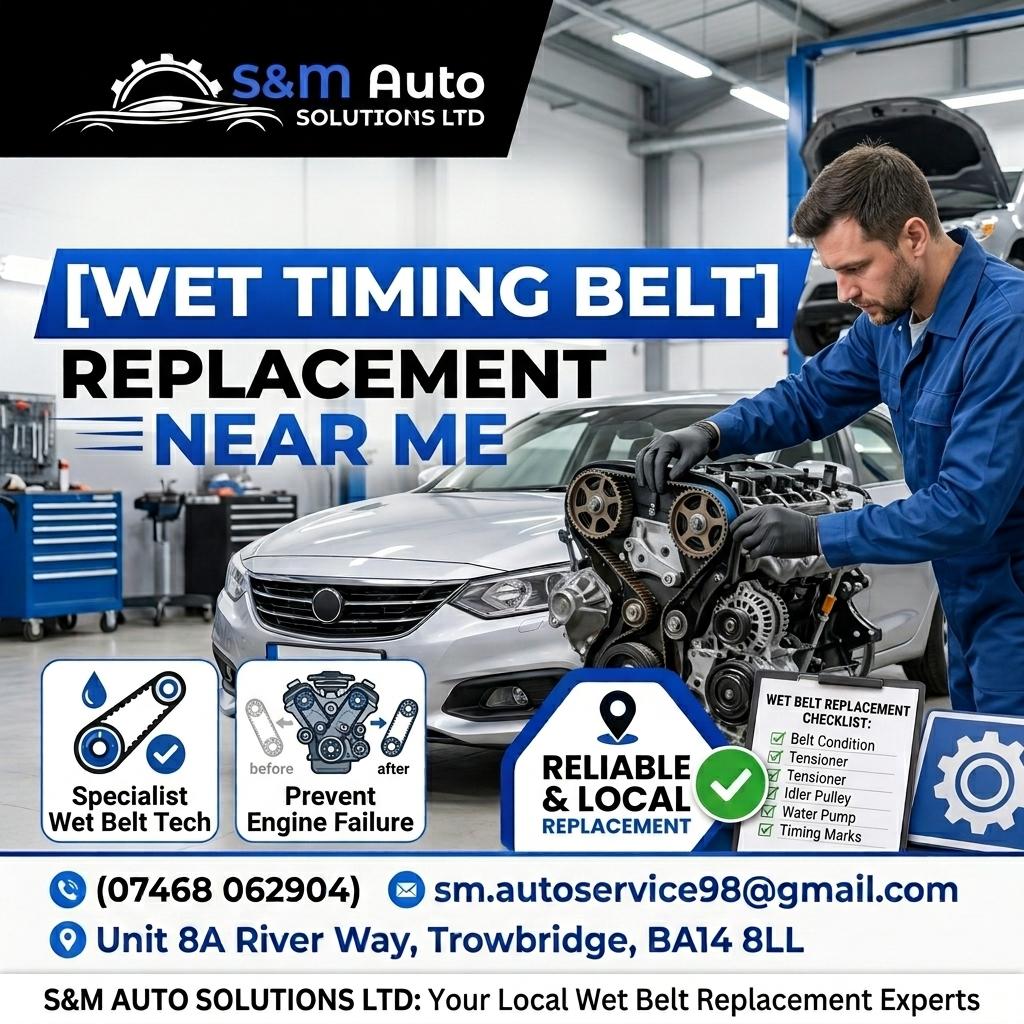
A vehicle’s timing system plays a critical role in keeping the engine running smoothly. While many drivers are familiar with conventional timing belts and chains, wet timing belts have become increasingly common in modern engines. Unlike traditional belts, these systems operate inside the engine and are lubricated by engine oil.
This design can provide advantages such as reduced friction, quieter operation, and improved packaging within the engine. However, it can also create additional maintenance considerations. Understanding how a wet timing belt works, what causes it to deteriorate, and what influences the wet timing belt replacement cost can help vehicle owners make better maintenance decisions.
For drivers in the UK, particularly those around Wiltshire and Trowbridge, knowing when professional inspection may be necessary can also help prevent avoidable engine problems.

What Is a Wet Timing Belt?
A wet timing belt, sometimes called an oil-bathed timing belt, performs the same fundamental job as a conventional timing belt: it synchronises the rotation of the engine’s crankshaft and camshaft.
The difference is where it operates.
A conventional timing belt normally runs outside the engine’s lubricated area, while a wet belt operates inside the engine and is exposed to engine oil. Manufacturers use this configuration to reduce mechanical friction, improve efficiency, and potentially lower noise levels.
The system typically consists of:
- A reinforced timing belt
- Crankshaft and camshaft pulleys
- Tensioners and guides
- Engine oil
- Associated seals and covers
Because the belt operates in oil, it must be manufactured from materials designed specifically for that environment. Using the wrong oil specification, extending service intervals, or allowing the oil to become contaminated may contribute to premature belt deterioration.
This makes correct servicing particularly important for vehicles equipped with wet timing belt technology.

What Influences Wet Timing Belt Replacement Cost?
One of the most common questions vehicle owners ask is how much replacing a wet timing belt will cost. There is no single price that applies to every vehicle because the job can vary considerably depending on the engine design and the amount of labour involved.
Several factors influence the overall wet timing belt replacement cost.
Vehicle and Engine Design
Different manufacturers use different wet belt systems. Access to the belt can vary substantially between engines, meaning some replacements require significantly more labour than others.
A technician may need to remove covers, ancillary components, engine mounts, or other parts before accessing the timing system.
Parts Required
A professional replacement may involve more than fitting a new belt. Depending on the manufacturer’s recommendations and the condition of the system, a replacement kit may include:
- Timing belt
- Tensioner
- Idler components
- Seals
- Gaskets
- Replacement bolts
- Engine oil and filter
Replacing related components at the same time can reduce the risk of having to dismantle the same area again later.

Labour Time
Labour is often a significant part of the overall cost. Wet belt systems can require careful preparation, removal, cleaning, installation, and timing verification.
The technician must ensure that the belt is correctly positioned and that the engine timing remains accurate. Incorrect installation can result in serious engine damage.
Engine Condition
The condition of the old belt can also affect the work involved. If the belt has deteriorated significantly, fragments of belt material may enter the engine’s oil circulation system.
This can potentially restrict oil passages or affect components such as the oil pickup system. Additional inspection and cleaning may therefore be necessary in severe cases.
Warning Signs of Wet Timing Belt Problems
Wet timing belts do not always provide obvious warning signs before developing a serious problem. This is one reason scheduled maintenance is important.
Nevertheless, several symptoms may justify professional inspection.
Potential warning signs include:
- Unusual engine noises
- Difficulty starting
- Rough or uneven engine operation
- Engine misfires
- Reduced performance
- Warning lights on the dashboard
- Oil contamination or unusual oil pressure symptoms
- Visible belt deterioration during inspection
Some symptoms can have causes unrelated to the timing belt, so diagnosis should be carried out before assuming that the belt itself is responsible.

A diagnostic inspection can help distinguish timing-related problems from issues involving ignition, fuel delivery, sensors, or other engine components.
Why Correct Oil Matters for Wet Belts
One of the most important maintenance considerations for an oil-bathed timing belt is engine oil specification.
Wet belts are designed to operate with particular oil formulations. Using an unsuitable lubricant may affect the belt’s material over time.
Drivers should therefore follow the vehicle manufacturer’s requirements for:
- Oil specification
- Oil viscosity
- Service intervals
- Oil filter replacement
- Approved replacement parts
Simply choosing an oil because it has a similar viscosity is not necessarily sufficient. Manufacturer specifications can include additional requirements relating to additives and chemical compatibility.
Regular oil and filter changes are also important because contaminated or degraded oil can increase the operating stresses placed on engine components.
Replacing Wet Timing Belt: What the Process Involves
The process of replacing wet timing belt systems is more involved than a routine visual belt check.
A professional procedure generally begins with confirming the vehicle’s engine code, service history, and manufacturer replacement requirements.

The technician may then:
- Prepare the vehicle and engine safely.
- Remove components required to access the timing system.
- Set the engine to the correct timing position.
- Remove the existing belt and associated components.
- Inspect relevant pulleys, tensioners, seals, and surrounding areas.
- Clean areas affected by belt material or oil contamination where required.
- Install the replacement belt and associated components.
- Set the correct tension according to manufacturer specifications.
- Verify engine timing.
- Replace oil and filters when appropriate.
- Start and test the engine.
- Check for leaks, abnormal noises, and correct operation.
The exact procedure differs between vehicles. This is why wet belt replacement should be carried out by technicians familiar with the specific engine design rather than treated as a generic belt replacement job.
Common Problems and How Drivers Can Reduce the Risk
Wet belt failures can sometimes be associated with neglected maintenance rather than simply the age of the belt.
Drivers can reduce potential risks by following a few practical habits.
Follow the Manufacturer’s Schedule
Timing belt replacement intervals are normally specified by the vehicle manufacturer. These recommendations may be based on mileage, age, or both.
Even vehicles that have relatively low annual mileage may eventually require replacement because timing belt materials can deteriorate with age.

Keep Service Records
Maintaining records of oil changes, filters, inspections, and timing belt work makes it easier to determine when maintenance is due.
Service documentation can also be valuable when a vehicle is sold or assessed.
Investigate Oil-Related Problems Promptly
Oil leaks, low oil levels, or repeated oil-pressure warnings should not be ignored. These issues can affect engine components and potentially contribute to wider mechanical problems.
Avoid Delaying Known Maintenance
A timing belt may appear to be functioning normally immediately before failure. Waiting for obvious symptoms is therefore not a reliable maintenance strategy.
Scheduled replacement is generally safer than relying on warning signs alone.
Wet Timing Belt Replacement in Trowbridge and the UK
Vehicle owners searching for wet timing belt replacement Trowbridge may find that local availability and workshop expertise are important considerations. A suitable garage should be able to identify the vehicle’s specific engine requirements and explain what parts and labour are included in the proposed work.
For example, information provided by S&M Auto Service about wet timing belt replacement in Trowbridge can be useful for drivers researching the process and potential costs before arranging an inspection.
The important point is to compare like-for-like quotations. A lower initial estimate may not include all components recommended by the manufacturer, while a higher quotation may include additional parts, fluids, or labour.
When discussing replacement, drivers should ask:
- Which parts are included?
- Is the oil and filter included?
- Are tensioners and seals being replaced?
- Does the work follow manufacturer specifications?
- What warranty applies to the replacement parts and labour?
- Will the engine be inspected for belt-related contamination?

These questions make it easier to understand the true scope of the work.
Final Takeaway
Wet timing belts are an important development in modern engine design, offering potential benefits in efficiency, noise reduction, and compact engine packaging. However, their operation inside the engine means maintenance requirements can differ from conventional timing belts.
The actual wet timing belt replacement cost depends on the vehicle, engine configuration, parts required, labour time, and condition of the existing system. Rather than focusing solely on the headline price, vehicle owners should consider the quality and completeness of the replacement procedure.
Regular servicing, correct engine oil, appropriate replacement intervals, and prompt investigation of unusual symptoms can all help protect the timing system.
For anyone considering wet timing belt replacement, understanding the manufacturer’s maintenance schedule and obtaining a clear, itemised assessment from a qualified technician are sensible first steps. Preventive maintenance can often be considerably less disruptive than dealing with the engine damage that may follow a neglected timing system.
Read More :
Top 10 Signs Your Wet Timing Belt May Need Replacing
Top 10 Things to Know About Timing Belt Replacements UK
Best 10 Guide to Wet Timing Belt Replacement in the UK
Best 10 Guide to Timing Belt Replacements Services in the UK
Best 10 Tips for Timing Belt Replacement Trowbridge

 English
 Arabic
 French
 Spanish
 Portuguese
 Deutsch
 Turkish
 Dutch
Dutch
 Italiano
 Russian
 Romaian
 Greek
Greek