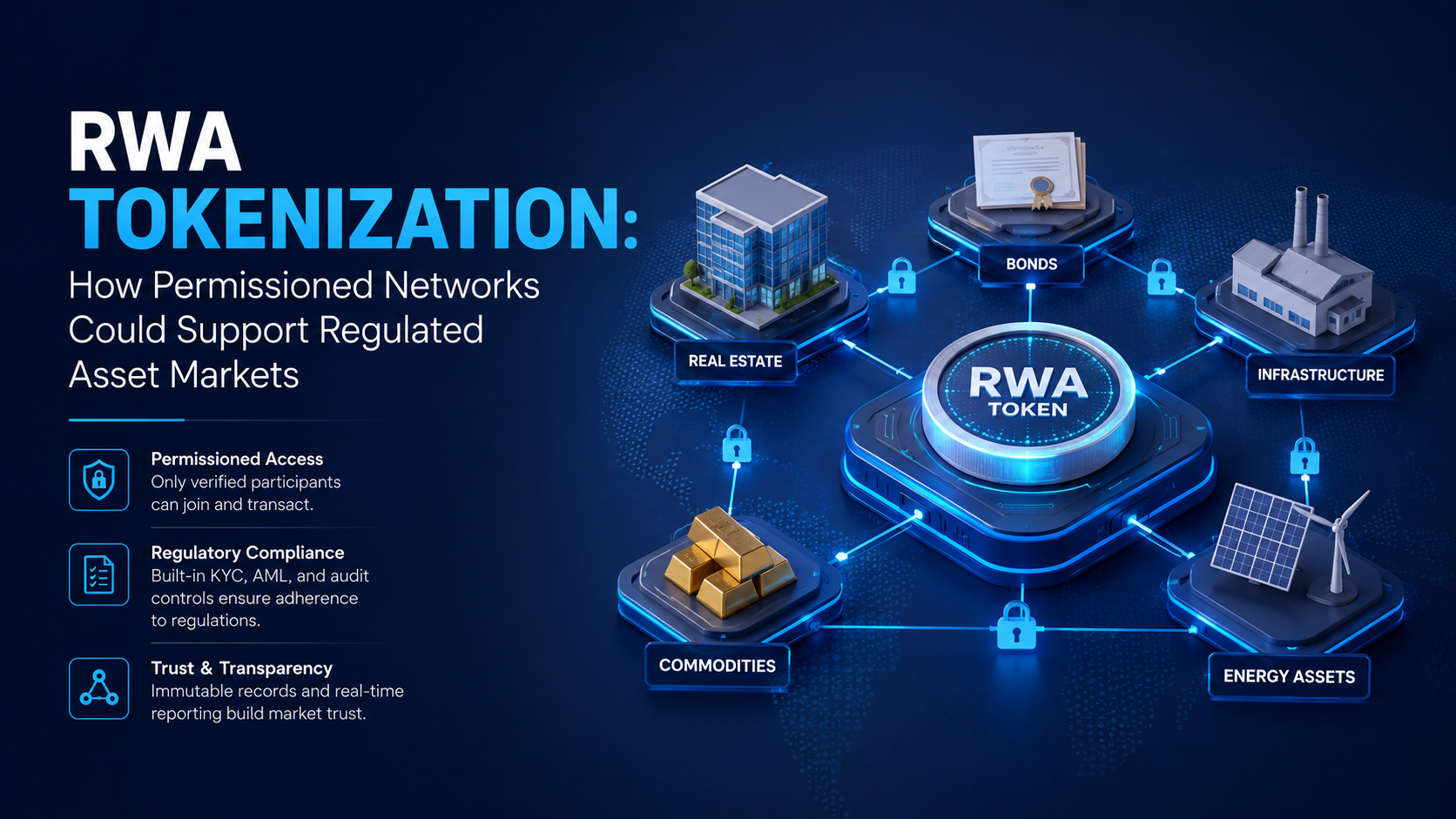
RWA tokenization is gaining attention as financial institutions, asset managers, private market operators, and businesses examine ways to represent real-world assets through blockchain-based tokens. Real estate, private credit, bonds, commodities, funds, invoices, and other financial interests can potentially be represented digitally, giving market participants new ways to issue, transfer, and manage ownership records.
However, regulated assets cannot operate under the same assumptions as unrestricted digital tokens. Securities laws, investor eligibility rules, identity checks, reporting duties, custody requirements, and transfer restrictions can all affect how an asset is issued and traded. This is where permissioned networks could become relevant.
Unlike public blockchain networks where participation is generally open, permissioned networks can restrict access to approved participants. A network can apply identity requirements, role-based permissions, transaction rules, and asset-specific restrictions before allowing an action to take place. For businesses considering RWA tokenization development, this approach can provide a framework for handling assets that require controlled participation.
What Is RWA Tokenization?
RWA tokenization refers to representing rights or interests connected to physical or financial assets as digital tokens on a blockchain or distributed ledger. The token does not automatically make someone the legal owner of an asset. Its legal meaning depends on the structure used for the issuance, the jurisdiction, the underlying agreement, and the rights attached to the token.
For example, a commercial property could be held through a legal entity, while digital tokens represent economic interests in that entity. Investors may receive income generated by the property according to the terms associated with their tokens. A similar structure could be applied to private debt, investment funds, commodities, or other asset classes.
This creates a connection between traditional legal arrangements and blockchain-based records. That connection requires careful attention to compliance because the digital representation and the underlying asset must work together.
Why Permissioned Networks Matter for Regulated Assets
Public blockchains offer broad participation, but regulated markets often require restrictions. Not every investor can purchase every financial product, and not every participant should have permission to transfer a particular token.
A permissioned network can place controls around who joins the network and what each participant can do. An issuer may have one set of permissions, an investor another, while custodians, administrators, brokers, regulators, and auditors may receive different levels of access.
This model can be useful when RWA tokenization involves assets subject to securities regulations, private-market restrictions, geographic limitations, or investor qualification requirements.
Instead of treating every blockchain address as an unrestricted participant, the network can associate approved identities with permitted activities.
Identity and Participant Verification
Identity management is one of the first areas where permissioned networks can support regulated token markets. Before investors receive tokens, platforms may need to conduct Know Your Customer and Anti-Money Laundering checks.
A permissioned environment can connect verified identities with blockchain accounts. Once a participant has passed the required checks, the system can assign permissions based on the investor's status and the relevant asset.
For example, an investor who has completed verification could receive access to a particular private credit offering. Another investor might be restricted because they do not meet the requirements for that offering.
This approach gives an RWA tokenization platform development project a mechanism for linking digital wallets with compliance status without treating every wallet address as automatically eligible.
Controlling Token Transfers
Token transfers can create regulatory issues when ownership restrictions apply. A token may be transferable only between approved investors, or transfers may be restricted during a specific period.
Permissioned networks can place rules around transfers. Before processing a transaction, the system can check whether both parties are authorized and whether the asset permits the proposed movement.
For example, imagine a token representing an interest in a private investment fund. An investor attempts to transfer the token to a new wallet. Instead of simply processing the transaction, the network can check whether the receiving party has completed the required verification and whether the transfer complies with the offering rules.
This type of transaction logic can reduce the possibility of unauthorized transfers.
Role-Based Access for Market Participants
Regulated asset markets usually involve several participants rather than just issuers and investors. Fund administrators, custodians, brokers, compliance teams, auditors, and other service providers may need access to different information or functions.
A permissioned network can assign roles to these participants. An issuer could manage asset issuance, while an administrator handles records and distributions. A custodian might have responsibilities related to asset custody, while an auditor could receive access to relevant transaction records.
This division can make the operational structure of an RWA tokenization platform more suitable for institutional markets.
An RWA tokenization company developing such a platform may therefore need to consider permissions as part of the system architecture rather than treating access control as a feature added later.
Smart Contracts and Compliance Rules
Smart contracts can automate many activities associated with tokenized assets. In a permissioned environment, they can also contain rules that reflect restrictions associated with a specific asset.
For example, a smart contract may check:
- Whether an investor is approved
- Whether a wallet is associated with a verified participant
- Whether a transfer is permitted
- Whether a holding period has ended
- Whether an investor has reached a prescribed ownership limit
- Whether a particular transaction requires administrative approval
The contract logic does not replace legal compliance. Instead, it can provide a technical mechanism for applying certain rules consistently.
For an RWA token development project, this means smart contracts need to be designed around the legal and operational structure of the asset rather than being treated only as transaction software.
Data Privacy and Controlled Information Sharing
Regulated markets often involve information that should not be publicly exposed. Investor identities, transaction details, financial records, and compliance information may require restricted access.
Permissioned networks can limit who can view particular information. This differs from many public blockchains where transaction activity can be visible to anyone examining the ledger.
A financial institution may therefore prefer a network where transaction records are available to authorized participants while sensitive investor information remains restricted.
Privacy design can also involve separating publicly available token information from private compliance records. The blockchain can record necessary transaction information while identity documents and detailed investor data remain in approved off-chain systems.
Asset Issuance Through Permissioned Networks
Issuance is another area where controlled networks can be useful. Before tokens are released, an issuer may need to confirm that the underlying asset has been reviewed and that the offering documentation is complete.
A permissioned system can assign issuance rights to approved parties. This can prevent unauthorized users from creating tokens representing an asset.
For instance, a tokenized bond platform could restrict token issuance to an authorized issuer. The number of tokens, issuance date, investor eligibility, and other parameters can be recorded according to the offering structure.
An RWA tokenization development company working on such a platform may need to connect the issuance process with legal documentation, asset verification, investor onboarding, and transaction monitoring.
Settlement and Record Management
Traditional asset transactions can involve several parties and separate recordkeeping systems. Settlement may require communication between brokers, custodians, administrators, and other intermediaries.
Permissioned distributed ledgers can provide a shared record of approved transactions among participating organizations. Depending on the structure, this could reduce duplicated reconciliation work and provide participants with a common transaction history.
However, the practical benefits depend on how the network is designed and which organizations participate. Simply placing an asset on a permissioned blockchain does not automatically remove existing settlement processes.
The value comes from connecting the ledger with the wider financial workflow.
Regulatory Reporting and Audit Trails
Regulated asset markets require records that can be reviewed by compliance teams, auditors, and regulators. A permissioned network can provide a structured transaction history for authorized parties.
Every approved transaction can be associated with relevant timestamps, participant identifiers, asset information, and transaction details. Additional records can remain in external systems when privacy or data-storage requirements call for it.
This can make the network useful for reviewing the movement of tokenized assets over time. It can also help organizations maintain an auditable history of issuance and transfers.
A Real-world asset tokenization company may therefore consider reporting and audit requirements during platform planning rather than treating them as separate administrative tasks.
Permissioned Networks vs Public Blockchains
The choice between a public and permissioned blockchain depends on the asset, participants, jurisdiction, and business model.
Public networks generally provide open participation and broad interoperability. They can offer access to a large ecosystem of wallets, applications, and liquidity venues. However, regulated assets may require restrictions that are harder to apply in an unrestricted environment.
Permissioned networks place greater emphasis on controlled participation. They can be appropriate when an asset requires verified investors, restricted transfers, institutional participation, or private transaction information.
There is also a possibility of hybrid models. A regulated asset platform might use a permissioned environment for compliance-sensitive activities while connecting to a public network for selected settlement or market functions.
How RWA Tokenization Platforms Could Use Permissioned Architecture
An RWA tokenization platform development company may divide the platform into several connected layers. These can include participant onboarding, identity verification, asset management, token issuance, smart contracts, compliance controls, custody, payments, and reporting.
The permissioned network can sit within this structure as the transaction and authorization layer. External systems can handle functions such as document storage, identity verification, banking connections, valuation data, and legal records.
A typical workflow could look like this:
- The issuer submits an asset for tokenization.
- The asset undergoes legal and financial review.
- Eligible investors complete identity and compliance checks.
- Approved investors receive permission to participate.
- Tokens are issued according to the offering structure.
- Transfers are checked against eligibility and asset rules.
- Approved transactions are recorded on the network.
- Income distributions or other asset events are processed.
- Authorized parties access records for administration and reporting.
The precise workflow would vary according to the asset and jurisdiction.
Challenges That Businesses Need to Consider
Permissioned networks do not remove the legal and operational challenges associated with RWA tokenization. The underlying asset still needs a valid legal structure, appropriate documentation, custody arrangements, and compliance processes.
Interoperability is another consideration. A tokenized asset may eventually need to interact with other financial systems or blockchain networks. A closed network can limit connectivity if its architecture does not support suitable standards and interfaces.
Governance also matters. Someone must decide who can join the network, who can change transaction rules, who can revoke permissions, and how disputes are handled.
There is also the question of network participation. If only one organization operates the entire infrastructure, the system may provide fewer benefits associated with shared infrastructure. A multi-party permissioned network requires agreement among participating institutions.
What Businesses Should Consider Before Development
Companies planning RWA tokenization development should begin with the asset and its legal rights rather than the blockchain technology alone. The first questions should concern what is being tokenized, what rights the token represents, who can hold it, how transfers should work, and which regulations apply.
From there, the technology architecture can be planned around those requirements. Network permissions, wallet management, smart contracts, identity verification, custody, reporting, data privacy, and integrations should all be considered together.
An RWA tokenization company can also evaluate whether a public, private, or hybrid architecture fits the intended market. The decision should be based on the required level of participant control, privacy, interoperability, and regulatory oversight.
Future Role of Permissioned Networks in RWA Markets
As financial institutions continue examining tokenized assets, permissioned networks could become useful infrastructure for markets where participation needs to be controlled. Their role may be particularly relevant for private funds, regulated securities, institutional credit, tokenized bonds, and other assets that involve defined investor groups.
The market may not settle on one blockchain architecture. Public networks, permissioned networks, and hybrid systems could coexist, with each serving different asset classes and transaction requirements.
For businesses entering this field, the important question may not be whether permissioned networks will replace public blockchains. Instead, it may be how different network models can work with legal structures, financial institutions, and regulated market processes.
Conclusion
RWA tokenization could give financial markets new ways to represent and manage real-world assets, but regulated assets require more than digital ownership records. Permissioned networks could provide a controlled environment where verified participants, restricted transfers, role-based permissions, privacy requirements, and compliance rules can be incorporated into the transaction process. Their value will depend on the legal structure of the asset, the participating institutions, the jurisdiction, and the wider technology ecosystem. Businesses considering RWA token development should therefore evaluate network architecture alongside custody, identity verification, smart contracts, reporting, and regulatory requirements. With the right structure, permissioned infrastructure could become an important component of regulated tokenized asset markets. Blockchain App Factory provides RWA tokenization development services for businesses planning blockchain-based asset platforms and related tokenization solutions.
FAQs
1. What is RWA tokenization?
RWA tokenization is the process of representing rights or interests connected to real-world assets through digital blockchain-based tokens.
2. What is a permissioned network?
A permissioned network is a blockchain or distributed ledger environment where participation and transaction activities are restricted to approved users or organizations.
3. Why could permissioned networks be useful for RWA tokenization?
They can provide controls for participant verification, restricted transfers, role-based permissions, and access to sensitive transaction information.
4. Can permissioned networks support regulated securities?
They can provide technical controls that may support regulated securities workflows, but the network itself does not make an asset legally compliant. Legal and regulatory requirements still need to be addressed.
5. How do permissioned networks control token transfers?
Transfer rules can check participant authorization, asset restrictions, holding periods, and other predefined conditions before a transaction is processed.
6. What is the role of smart contracts in permissioned RWA platforms?
Smart contracts can automate approved activities such as issuance, transfer checks, distributions, and other asset-related processes according to predefined rules.
7. Is a permissioned blockchain better than a public blockchain for RWA tokenization?
There is no universal choice. Permissioned networks may suit assets requiring controlled participation, while public networks may offer wider ecosystem access. Hybrid models can also be considered.
8. What does an RWA tokenization development company typically work on?
An RWA tokenization development company may work on token issuance systems, smart contracts, investor onboarding, compliance controls, wallet management, asset administration, reporting, and blockchain integrations.
9. What should businesses consider before RWA tokenization platform development?
Businesses should evaluate the legal structure of the asset, applicable regulations, investor requirements, custody, transfer restrictions, data privacy, network architecture, and integration requirements before starting development.




 English
 Arabic
 French
 Spanish
 Portuguese
 Deutsch
 Turkish
 Dutch
Dutch
 Italiano
 Russian
 Romaian
 Greek
Greek