


Features to Look for in a Commercial Chapati Making Machine
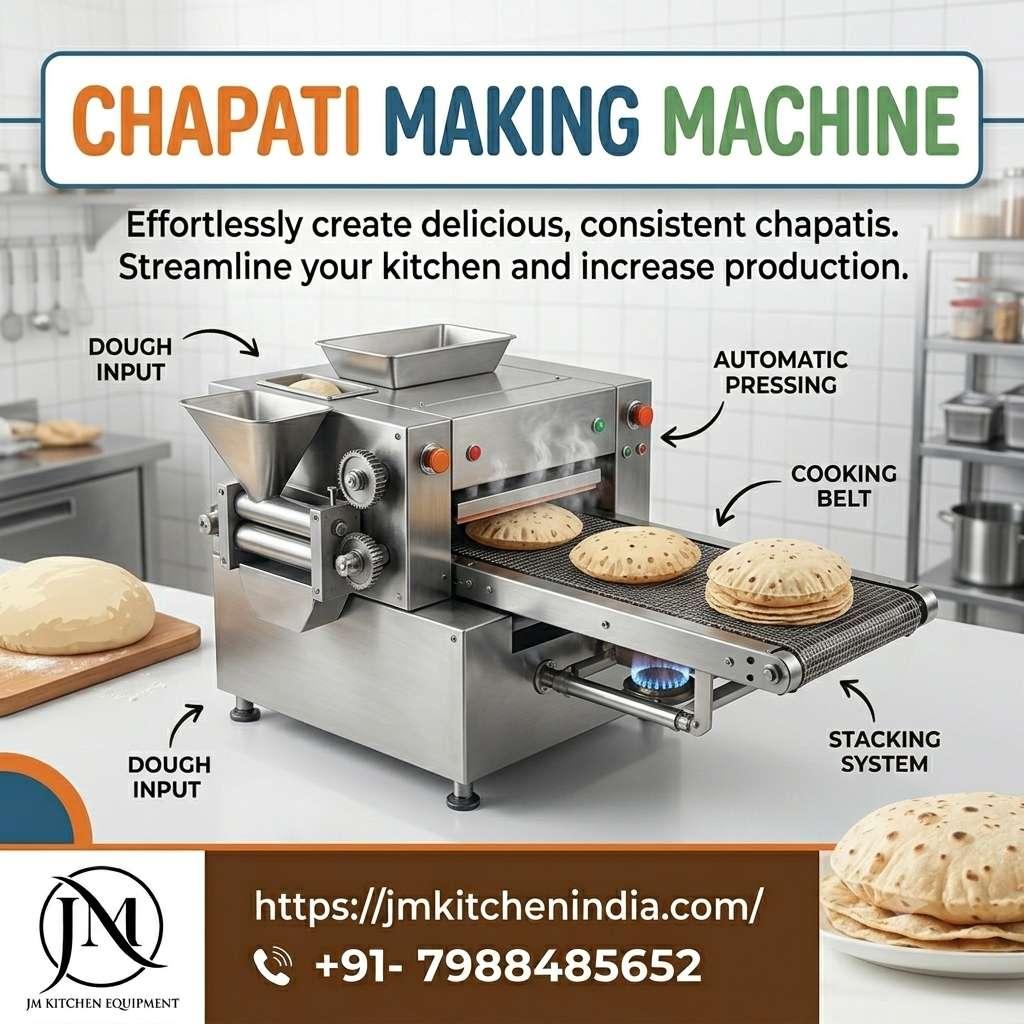
Preparing chapatis in large quantities can be time-consuming for restaurants, hotels, canteens, catering companies, and institutional kitchens. As food businesses grow, relying completely on manual preparation can put additional pressure on kitchen staff and make it harder to maintain consistent production.
A commercial chapati making machine can simplify this process by supporting faster and more uniform chapati preparation. However, choosing the right machine requires more than checking its production capacity. Businesses should consider construction quality, operation, cleaning, safety, consistency, and suitability for their daily workload.
JM Kitchen Equipment provides commercial kitchen solutions for professional food businesses. When selecting a chapati making machine, understanding the important features can help businesses make a practical investment that matches their production requirements.
1. Suitable Production Capacity
The first feature to consider is production capacity. Every business has different requirements depending on the number of customers it serves and the quantity of chapatis prepared each day.
A small restaurant may need a different machine capacity compared with a large hotel, canteen, or catering operation. Choosing a chapati making machine according to actual production needs helps prevent unnecessary investment while ensuring that the equipment can keep up with demand.
Businesses should consider both regular production and peak-hour requirements before making a decision.
2. Consistent Chapati Size and Thickness
Consistency is important in commercial food preparation. Customers generally expect chapatis to have a similar size, thickness, and appearance with every order.
A good chapati making machine should support uniform shaping and production. Consistent output makes portion management easier and helps maintain a professional presentation.
For businesses serving large numbers of customers, this consistency can also reduce variations that commonly occur with completely manual preparation.
3. Durable Construction
Commercial kitchen equipment is used repeatedly throughout the day, so durability should be an important consideration.
Look for a chapati making machine manufactured with strong, food-suitable materials and designed for regular commercial use. A sturdy construction can help the machine withstand continuous operation and everyday handling.
Durable equipment can also provide better long-term value when combined with proper cleaning and preventive maintenance.
4. Easy and Practical Operation
Kitchen staff often work under pressure, particularly during busy meal periods. Equipment that is complicated to operate can slow down production rather than improve it.
A practical chapati making machine should have straightforward controls and an operating process that staff can understand easily. Simple operation also makes employee training easier.
Before purchasing, businesses should ensure that operators receive proper instructions on starting, operating, cleaning, and safely shutting down the machine.
5. Food-Safe Contact Surfaces
Hygiene is essential in any commercial kitchen. Components that come into contact with dough should be made from appropriate food-safe materials and designed for regular cleaning.
A well-designed chapati making machine should provide accessible surfaces that can be cleaned effectively after production. Smooth and properly finished surfaces can make it easier to remove flour and dough residue.
Good hygiene practices should always be followed alongside the use of quality equipment.
6. Easy Cleaning and Maintenance
Cleaning should be considered before buying any commercial machine.
Dough and flour can accumulate during daily production. If a chapati making machine is difficult to clean, staff may spend more time maintaining it or may overlook certain areas.
Choose equipment that allows routine cleaning to be performed conveniently. Businesses should also check the manufacturer's recommendations regarding cleaning products, maintenance intervals, and service requirements.
Regular cleaning helps maintain performance and supports a hygienic production environment.
7. Reliable Heating and Cooking Performance
For machines that include an integrated cooking process, heating performance is another important consideration.
The cooking section should provide appropriate and consistent heat for the intended production process. Uneven heating can affect the appearance and texture of chapatis.
When evaluating a chapati making machine, businesses should consider how the heating system works, how it is controlled, and whether it is suitable for their expected production volume.
8. Safety Features
Commercial kitchen equipment should be designed with operator safety in mind.
A chapati making machine may include moving components and heating elements, so employees should understand safe operating procedures. Protective features, appropriate controls, and proper machine placement can help create a safer working environment.
Staff should never attempt to clean or service moving or heated components while the machine is operating. Technical repairs should be handled by qualified personnel.
9. Efficient Use of Kitchen Space
Kitchen space is often limited, particularly in restaurants and cafés.
Before selecting a chapati making machine, measure the available installation area and consider how employees will move around it. The machine should fit comfortably without blocking preparation tables, storage areas, walkways, or other equipment.
A well-planned layout can make the machine easier to operate and integrate into the overall kitchen workflow.
10. Energy and Operating Requirements
Operating costs matter over the entire life of commercial equipment.
Businesses should understand the machine's power requirements before installation. The available electrical or fuel connection should be compatible with the equipment specifications.
Selecting a chapati making machine that matches the kitchen's infrastructure can help avoid installation complications and support efficient daily operation.
11. Availability of Service and Spare Parts
Even reliable equipment may eventually require servicing or replacement components.
Before purchasing a chapati making machine, ask about after-sales support, spare parts availability, maintenance procedures, and technician assistance. Good service support can reduce downtime when technical problems occur.
A manufacturer that understands commercial kitchen requirements can also provide useful guidance on installation and maintenance.
Why Choose JM Kitchen Equipment?
JM Kitchen Equipment offers commercial kitchen equipment solutions for restaurants, hotels, cafés, canteens, catering companies, cloud kitchens, and institutional food businesses.
Our range of solutions is focused on practical commercial requirements, including durability, hygiene, efficient operation, and suitable equipment selection. When choosing a chapati making machine, businesses can evaluate their production volume, available space, kitchen workflow, and future requirements to identify the most appropriate solution.
A professional approach to equipment selection helps businesses avoid purchasing machinery that is either unsuitable for their workload or unnecessarily large for their operation.
How to Get Better Performance from Your Machine
Buying the right equipment is only the beginning. Proper use and maintenance are equally important.
Businesses should clean the chapati making machine regularly, remove flour and dough residue, follow operating instructions, inspect components periodically, and arrange professional servicing when required.
Staff training is also important. Employees who understand the correct operating and cleaning procedures are more likely to use the equipment safely and efficiently.
Conclusion
Choosing a commercial chapati making machine requires careful consideration of production capacity, consistency, construction, safety, cleaning, heating performance, space requirements, and after-sales support. The right combination of these features can help businesses improve their chapati production while maintaining a smooth kitchen workflow.
For restaurants, hotels, canteens, catering companies, and institutional kitchens, the best machine is not necessarily the biggest or most expensive option. It is the one that matches the business's actual production needs and can deliver reliable performance with proper care.
JM Kitchen Equipment provides commercial kitchen solutions designed for professional food preparation environments. By selecting a suitable chapati making machine and maintaining it correctly, businesses can improve productivity, reduce repetitive manual work, and build a more efficient food production process.

 Arabic
 French
 Spanish
 Portuguese
 Deutsch
 Turkish
 Dutch
Dutch
 Italiano
 Russian
 Romaian
 Portuguese (Brazil)
 Greek
Greek