


4 Inch Round Labels: Uses, Benefits, and Customization Ideas
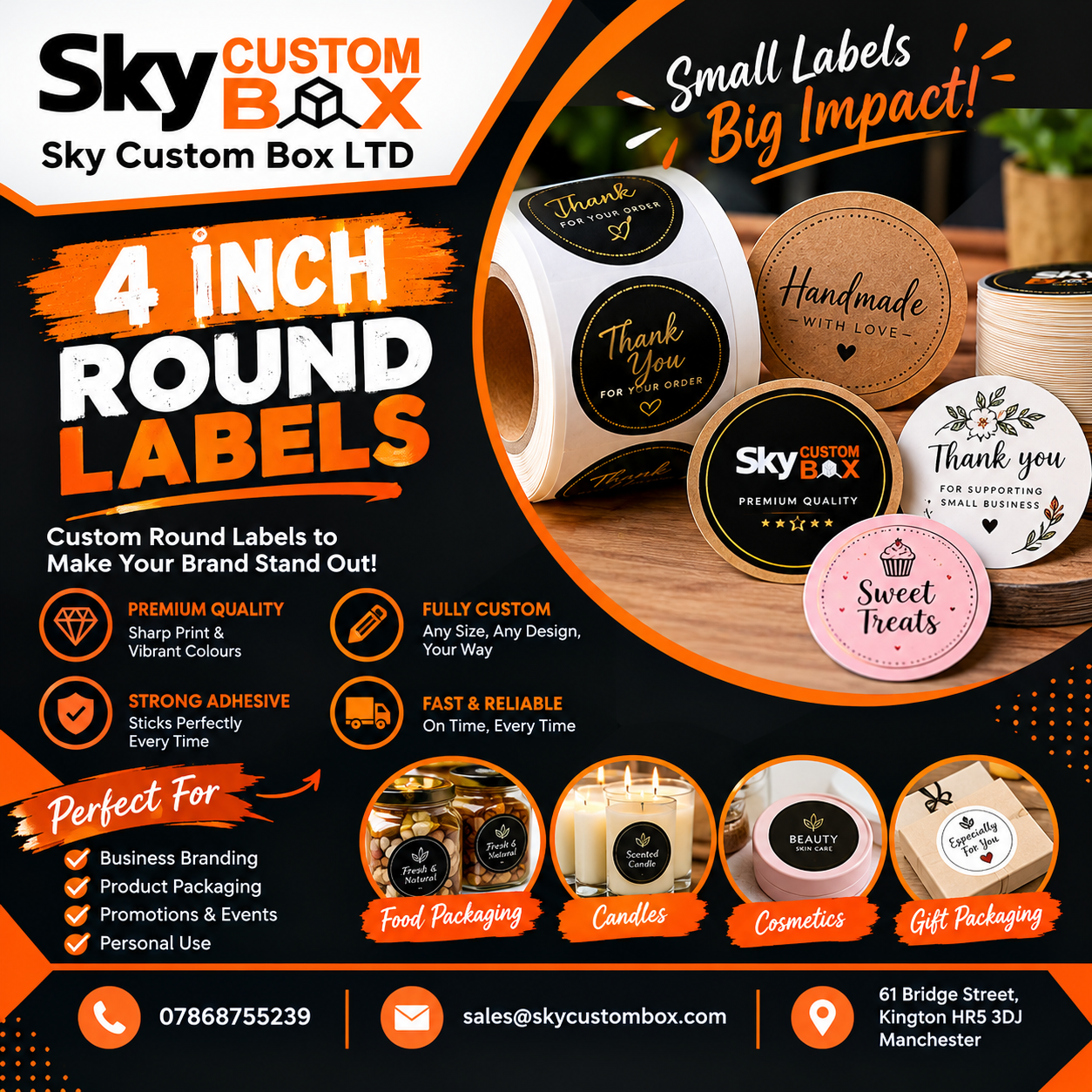
Product labels are often one of the first visual elements a customer notices on packaging. They can provide essential information, reinforce brand identity, and make otherwise simple packaging look more polished. Among the many label formats available, large circular labels are particularly useful when businesses need enough space for branding, instructions, promotional messaging, or product details.
While smaller formats such as 1 inch round labels, 2 inch round labels, and 3 inch round labels are commonly used for compact packaging, 4 inch round labels provide considerably more surface area. This makes them suitable for larger boxes, bags, containers, retail displays, and other packaging applications where visibility matters.
Understanding the advantages, applications, and customization options of large round labels can help businesses select a format that works with both their packaging design and practical requirements.
What Are 4 Inch Round Labels?
A 4-inch round label is a circular adhesive label measuring approximately four inches in diameter. Its relatively large printable area gives designers more room to combine logos, text, graphics, product information, and decorative elements without making the design difficult to read.
The size sits toward the larger end of commonly used circular product labels. As a result, it is often selected when a small sticker would not provide enough visual impact or information space.
The actual appearance of a label depends on several factors, including:
- Label material
- Adhesive type
- Printing method
- Surface finish
- Colour scheme
- Packaging surface
- Intended indoor or outdoor use
Paper remains a practical option for many retail packaging applications, while synthetic materials can be more appropriate where moisture, handling, or durability is a concern.
Common Uses for Large Round Labels
Large circular labels can serve many purposes across packaging and retail. Their versatility comes from the combination of substantial printable space and an easily recognizable shape.
1. Product Branding
A 4-inch circular sticker can function as a prominent branding element on a box, paper bag, jar, pouch, or mailer. Businesses can place their logo in the centre and use the surrounding area for supporting visual elements.
For minimalist packaging, a simple logo with a short brand message can create a clean appearance. More detailed designs can incorporate patterns, illustrations, or brand colours.
2. Packaging Seals
Round labels are frequently used as packaging seals. A sticker placed across a flap or opening can help indicate whether packaging has been opened or handled.
This is particularly useful for:
- Gift packaging
- Bakery boxes
- Retail bags
- Product cartons
- Subscription packaging
- Handmade goods
A seal does not necessarily replace tamper-evident packaging where formal security is required, but it can provide a practical visual closure for many everyday packaging applications.
3. Promotional Packaging
Businesses can use large round stickers to communicate temporary campaigns without redesigning the entire package. For example, a label may highlight a seasonal collection, special edition, new product, or limited-time message.
Because the sticker is separate from the main package, promotional artwork can be changed while the underlying packaging remains consistent.
4. Food and Bakery Packaging
Circular labels are popular within food-related packaging because they can accommodate product names, brand marks, flavour descriptions, or short handling information.
For bakery businesses, for example, a round label can add branding to cake boxes, pastry bags, takeaway packaging, and gift boxes. However, businesses should select materials and adhesives appropriate for the specific food-packaging environment and applicable regulations.
5. Retail and Handmade Products
Small retailers and independent product makers often use labels to create consistency across different packaging formats. A large round label can visually connect products that use different boxes, bags, jars, or containers.
This approach is particularly useful for candles, cosmetics, craft products, gifts, stationery, and other consumer goods.
Choosing Between 1, 2, 3, and 4 Inch Round Labels
Label size should be based on the packaging dimensions, design requirements, and amount of information that needs to be displayed.
1 inch round labels are generally suited to small logos, seals, tags, and compact products. Their limited space encourages very simple designs.
2 Inch round labels offer more flexibility while remaining relatively compact. They can accommodate logos, short messages, or simple product identifiers.
3 Inch round labels provide a useful middle ground for packaging that needs stronger visual presence without requiring a very large sticker.
4 Inch round labels are better suited to larger packaging surfaces where the label needs to be noticeable or contain several design elements.
Before selecting a size, businesses should measure the available packaging area rather than choosing a label based solely on appearance. A large sticker can overwhelm a small package, while a tiny label may become difficult to notice on a large box.
Customization Ideas for 4 Inch Round Labels
The larger surface area of a four-inch label creates numerous design possibilities. However, having more space does not mean every available area should be filled.
Keep the Main Message Clear
A strong label normally has one obvious focal point. This might be a brand logo, product name, illustration, or promotional message.
Avoid using too many competing elements. A clear hierarchy can help customers understand the label quickly.
For example:
- Brand or product name
- Main visual element
- Supporting message
- Secondary information
This structure improves readability, especially when packaging is viewed from a distance.
Consider Typography Carefully
Large labels allow for more text, but readability should remain the priority. Choose typefaces that match the brand while maintaining sufficient contrast against the background.
Small decorative text can be difficult to read once labels are applied to curved containers or viewed under retail lighting.
Use Colour Strategically
Colour can reinforce brand recognition and distinguish product variations. A business might use related colours for different flavours, scents, sizes, or collections while keeping the core branding consistent.
Colour selection should also account for the label material and printing process. A colour that looks one way on a digital screen may appear somewhat different when printed.
Explore Finishes
Finishing options can influence both appearance and perceived quality. Depending on the application, businesses may consider:
- Matte finishes for a soft, understated appearance
- Gloss finishes for stronger colour and shine
- Transparent materials for a more integrated look
- Textured stocks for tactile packaging
- Foil or metallic effects for selected premium applications
The appropriate finish depends on the product, packaging material, brand style, and expected handling conditions.
Common Challenges and How to Avoid Them
Even a well-designed label can perform poorly if practical factors are overlooked.
Poor Adhesion
Labels may lift or peel when applied to dusty, oily, textured, or unsuitable surfaces. Cleaning and preparing the packaging surface before application can improve adhesion.
Businesses should also check whether the adhesive is designed for paper, cardboard, glass, plastic, or another material.
Overcrowded Designs
A larger label can tempt designers to include too much information. More space should be used to improve hierarchy and visual balance, not simply to add more words.
A useful test is to view the label at its intended application distance. If the main information is not immediately obvious, the design may need simplifying.
Incorrect Sizing
A four-inch circle needs adequate clear space around it. Designers should account for seams, folds, handles, corners, windows, and other packaging features before finalizing the artwork.
Creating a physical mock-up can help identify sizing problems before a large production run.
Insufficient Bleed and Safe Areas
Printed labels usually require appropriate bleed and safe margins. Artwork extending to the edge should be prepared according to the printer's specifications to reduce the risk of visible unprinted edges.
Important text and logos should remain comfortably inside the trim area.
Trends in Custom Packaging Labels
Packaging design continues to move toward personalization, simplicity, and stronger brand storytelling. Instead of relying solely on elaborate packaging structures, businesses can use flexible elements such as stickers and labels to update designs efficiently.
Sustainable packaging is another important consideration. Many businesses are examining recyclable materials, responsibly sourced papers, and packaging designs that reduce unnecessary material use. Label choices should be considered as part of the overall packaging system rather than evaluated separately.
Digital printing has also made smaller customized runs more practical for businesses testing new products or seasonal designs. This can be particularly useful for independent retailers that need several variations without committing to one large standardized design.
Packaging providers such as Sky Custom Box can serve as useful reference points for businesses exploring how custom labels and other packaging components can work together as part of a cohesive retail presentation.
Practical Tips Before Printing
Before sending a round-label design to production, review the following points:
- Measure the exact application area.
- Confirm the label diameter.
- Check the surface material and texture.
- Select an adhesive appropriate for the application.
- Use high-resolution artwork.
- Maintain readable typography.
- Confirm colour requirements with the printer.
- Allow appropriate bleed and safe margins.
- Request a proof when possible.
- Test the label on the actual packaging before placing a larger order.
These steps can prevent common problems such as incorrect sizing, weak adhesion, poor readability, or unwanted visual imbalance.
Conclusion
4 Inch Round Labels offer a practical combination of visibility, design flexibility, and packaging functionality. Their larger printable surface makes them suitable for branding, packaging seals, promotional campaigns, food and bakery packaging, handmade products, and many retail applications.
Read More:
Best Packaging Boxes for Small Business UK
How to Choose the Best Kraft Cake Boxes with Window for Your Bakery

 English
 Arabic
 French
 Portuguese
 Deutsch
 Turkish
 Dutch
Dutch
 Italiano
 Russian
 Romaian
 Portuguese (Brazil)
 Greek
Greek