


OCI Card Application Guide: Eligibility, Documents and Online Steps
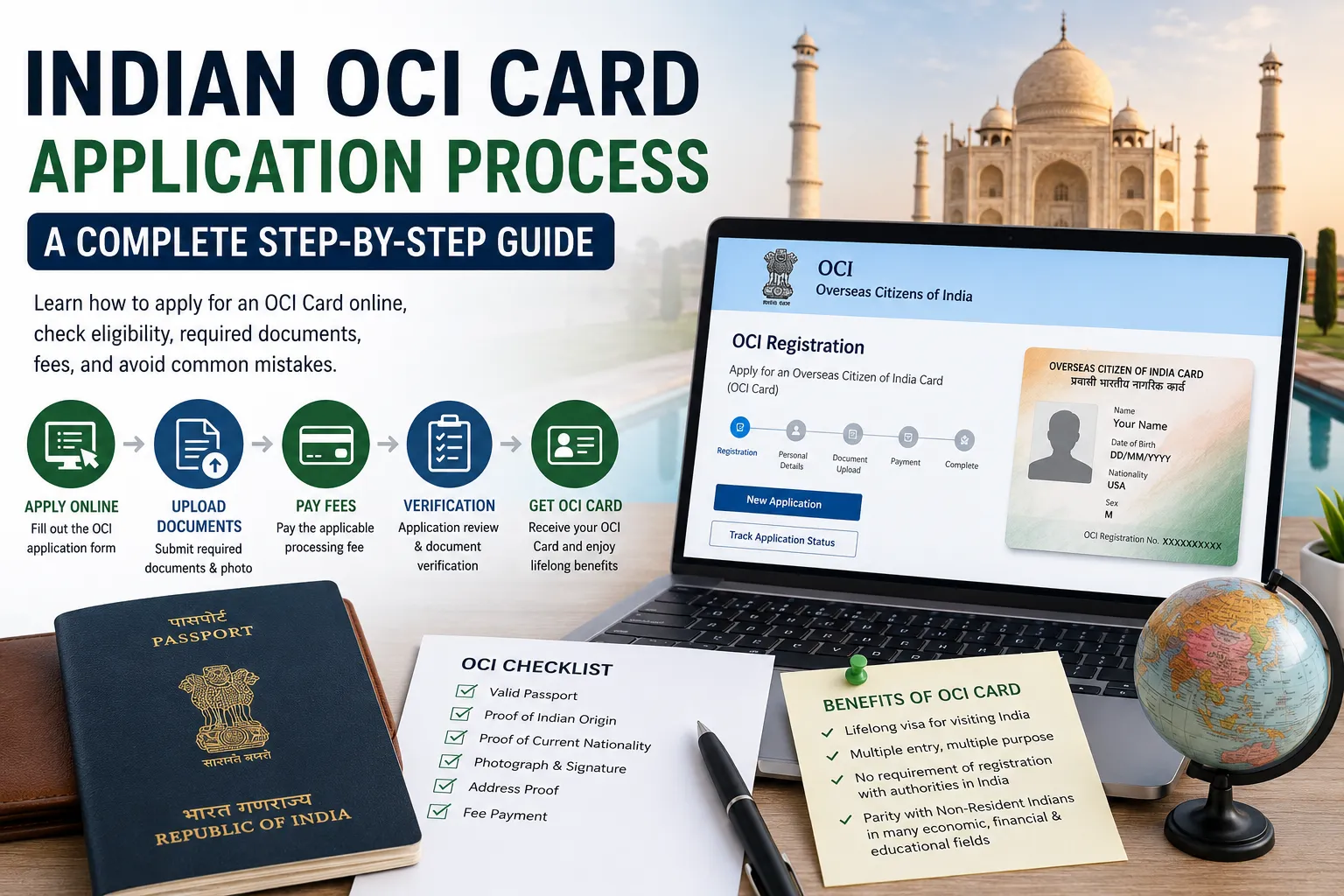
For foreign citizens with Indian roots, an Overseas Citizen of India Card can make maintaining a connection with India much easier. The OCI scheme provides eligible foreign nationals with specific immigration and other benefits, including a multiple-entry, lifelong visa for visiting India, subject to applicable rules.
However, an OCI application is more than an online form. Applicants may need to prove their current citizenship, establish Indian origin, demonstrate family relationships, provide address evidence, and submit photographs and signatures that meet technical requirements.
The most effective way to avoid unnecessary problems is to understand the process before submitting anything.
This guide explains the important stages of the application and highlights practical issues that applicants should consider before they begin.
What Is an OCI Card?
OCI stands for Overseas Citizen of India. It is a special status available to certain foreign citizens who have qualifying connections to India.
An OCI Card does not mean that the holder has Indian citizenship. The Government of India explains that India's constitutional framework does not permit simultaneous Indian citizenship and foreign citizenship. OCI is instead a separate immigration status created for qualifying persons of Indian origin.
Registered OCI Cardholders can receive benefits such as a multiple-entry, lifelong visa for visiting India and certain specified parity with Non-Resident Indians in financial, economic, and educational fields, subject to applicable restrictions.
Understanding this distinction is important. An OCI Card is not an Indian passport and should not be treated as dual citizenship.
Who Is Eligible for OCI Registration?
Eligibility should be checked before preparing the application.
Under Section 7A of the Citizenship Act, the Government of India's current OCI guidance identifies several qualifying categories. These include certain foreign citizens who were Indian citizens on or after January 26, 1950, people who would have been eligible for Indian citizenship at the commencement of the Constitution, and people connected to territories that became part of India after August 15, 1947.
Certain children, grandchildren, and great-grandchildren of qualifying individuals may also be eligible. Minor children of qualifying persons and certain minor children with an Indian citizen parent can qualify under the applicable provisions.
Foreign spouses can also qualify in specific circumstances. The current official guidance states that a foreign-origin spouse of an Indian citizen or OCI Cardholder may apply when the marriage has been registered and has continued for at least two years immediately before the application, along with the other applicable conditions.
Check for Eligibility Restrictions
Some applicants may discover that their family history affects eligibility.
The official OCI FAQ states that a person is not eligible if the applicant, or either parent, grandparent, or great-grandparent, is or was a citizen of Pakistan, Bangladesh, or another country that the Central Government specifies through notification.
This is especially important for people applying through ancestry.
Before spending time obtaining documents, review the citizenship history of the relevant parents, grandparents, and great-grandparents when ancestry is the basis of the application.
Decide How You Qualify Before Collecting Documents
One of the most useful preparation steps is to identify your exact eligibility category.
For example, you may be applying because:
- You previously held Indian citizenship.
- Your parent was an Indian citizen.
- Your grandparent or great-grandparent qualifies under the OCI rules.
- You are a qualifying minor child.
- You are the foreign-origin spouse of an eligible Indian citizen or OCI Cardholder.
Each situation can require different evidence.
A former Indian citizen may need documents relating to a previous Indian passport and surrender of that passport. Someone applying through a grandparent may instead need several generations of civil records establishing the family relationship.
Knowing your category first helps you avoid submitting an application with documents that do not actually prove your eligibility.
What Documents Are Commonly Required?
The exact requirements depend on the applicant's circumstances, but the official OCI FAQ lists several categories of supporting evidence.
These may include:
- Current valid foreign passport
- Citizenship or naturalization certificate
- Previous Indian passport, where applicable
- Surrender Certificate, where applicable
- Proof of address
- Evidence of Indian origin
- Birth certificates
- Documents establishing parent-child relationships
- Evidence connecting the applicant with a qualifying grandparent or great-grandparent
- Marriage certificate for eligible spouse applications
- Additional civil or legal documents when relevant
The official OCI guidance states that a copy of the current valid passport is required in all cases and that it should have at least six months of validity at the time of application.
Applicants should not assume that every person needs the same checklist. The correct documents depend on the reason for eligibility.
How to Prove Indian Origin
For many applicants, proof of Indian origin is the central part of the application.
The official guidance identifies documents such as an Indian passport, domicile certificate, nativity certificate, qualifying PIO or OCI records, and other evidence that can substantiate Indian origin.
If you qualify through a parent, grandparent, or great-grandparent, you also need to establish the family relationship.
Think of your evidence as a chain:
Applicant → Parent → Grandparent → Indian-origin evidence
If you are claiming eligibility through a great-grandparent, the chain may include more generations.
Birth certificates can be especially important because they may identify parents and therefore connect one generation to the next. The official OCI guidance also explains that foreign-issued documents may require apostille or appropriate certification depending on where they were issued.
What If Your Documents Have Different Names?
Name differences can create confusion during document verification.
For example, an old Indian passport might contain a shortened name while a current foreign passport uses a full name. A marriage may also have resulted in a surname change.
Before submitting your application, compare the names across your passport, birth certificate, marriage certificate, citizenship documents, and Indian-origin records.
If there is a legitimate reason for a difference, prepare supporting documentation that explains the change.
The objective is to make it clear that all of the documents relate to the same applicant or family relationship.
How to Apply for an OCI Card Online
The OCI registration application is submitted through the official online OCI system. The Government of India's portal specifically instructs applicants to apply online and review the instructions before beginning the form.
Step 1: Confirm Eligibility
Determine the exact basis for your OCI application.
Step 2: Prepare Your Passport
Have your current foreign passport available. The official registration system instructs applicants to enter details according to their current passport.
Step 3: Register Online
The online registration system asks for information such as surname, given name, date of birth, email address, nationality, and mobile number. Applicants should use an active email address and keep their login information secure.
Step 4: Complete the Application
Enter your personal information, citizenship history, family details, address, and OCI eligibility information.
Take your time. Do not guess information when the original document is available.
Step 5: Upload Supporting Files
Upload the applicable passport copy, photograph, signature, and supporting documents according to the current specifications.
Step 6: Review Everything
Check names, dates, passport numbers, addresses, family relationships, and document uploads before final submission.
Step 7: Complete Verification
After submitting the online application, applicants generally need to present the original supporting documents to the Indian Mission, Post, or FRRO having jurisdiction, as applicable.
Photograph and Signature Requirements
Technical file requirements should not be overlooked.
The current OCI FAQ states that the uploaded photograph must be square, with minimum dimensions of 200 by 200 pixels and maximum dimensions of 900 by 900 pixels. It also specifies JPEG/JPG format and a maximum file size of 200 KB for the photograph and signature.
Before uploading, check:
- Image dimensions
- File size
- File format
- Background
- Face positioning
- Image quality
- Signature quality
A technically incorrect image can create an avoidable processing problem.
What Happens During Document Verification?
After the online application and document uploads are complete, applicants must follow the verification instructions applicable to their location.
The official OCI FAQ states that applicants should bring the original supporting documents for prior verification. After the originals are checked, they are returned to the applicant.
Applicants should therefore keep their original documents organized and accessible.
There is generally no need to assume that every applicant must bring a large printed application package. The current official guidance specifies what is required for verification, so applicants should follow those instructions rather than relying on older checklists.
Are Interviews Required?
The verification process depends on the application category.
For most OCI registration applications, there is no personal interview. However, the official guidance states that applicants applying under the foreign-spouse category are subject to a mandatory personal interview during document verification.
This is another reason why selecting the correct eligibility category is important.
What About Biometrics?
Biometric collection is part of the OCI registration process.
The official OCI FAQ states that fingerprints and facial biometrics, where technically feasible, are mandatory for OCI registration applicants. For applications submitted at Indian Missions or Posts abroad, applicants can have options concerning when biometrics are provided under the current procedure.
Applicants should follow the instructions provided by the relevant authority rather than relying on an older experience from another applicant.
Common OCI Application Mistakes
Applying Before Checking Eligibility
Do not begin with the application form. Start with eligibility.
Using Outdated Passport Information
The current OCI registration system instructs applicants to enter details according to their current passport.
Missing a Family Link
If your application depends on Indian ancestry, make sure the documents connect each relevant generation.
Uploading Incorrect Files
Check image dimensions, file size, and document readability before uploading.
Ignoring Citizenship History
Former Indian citizens should review their previous Indian citizenship documents and applicable surrender documentation.
Treating All Applications the Same
A spouse-based application, minor application, former Indian citizen application, and ancestry-based application can involve different evidence.
Relying on Old Online Advice
OCI requirements can change. Always compare third-party information with the current official OCI portal before submitting.
How to Make Your Application More Organized
Create a simple document system before starting.
Keep one folder for current identity documents, one for Indian-origin evidence, one for family relationship records, and another for citizenship history.
You can also maintain a digital copy of your submitted application, uploaded documents, payment information, and correspondence.
This organization can be useful if an authority requests clarification later.
What Are the Benefits of OCI Status?
OCI status can make repeated visits to India easier for eligible foreign nationals.
The Government of India's OCI portal lists benefits including a multiple-entry, lifelong visa for visiting India and exemption from reporting to police authorities for any length of stay in India. It also describes certain parity with Non-Resident Indians in financial, economic, and educational areas, subject to stated restrictions.
OCI status does not, however, give the holder all rights associated with Indian citizenship.
A Practical Pre-Submission Checklist
Before you apply for an OCI Card, review these points:
- Confirm your eligibility.
- Identify the correct application category.
- Check your current passport validity.
- Make sure passport details are entered correctly.
- Gather proof of Indian origin.
- Establish family relationships where required.
- Collect citizenship and naturalization documents.
- Prepare surrender documentation if applicable.
- Check names across all records.
- Prepare the required photograph and signature.
- Make sure uploaded documents are clear.
- Review the entire application before submission.
- Check local document-verification instructions.
- Keep your original documents available.
- Monitor the application after submission.
Final Thoughts
The Indian OCI Card application process becomes easier when you prepare the evidence before filling out the online form.
Start with eligibility. Then build your document package around the specific reason you qualify. If your application is based on Indian ancestry, create a clear family-document chain. If you previously held Indian citizenship, organize your citizenship and surrender records. If you are applying through marriage, check the separate spouse requirements.
Accuracy also matters. Your current passport details, personal information, family records, photographs, and supporting documents should tell a consistent story.
If you want to apply for an OCI Card, use the official OCI portal as your primary source for the latest instructions. The Government of India provides the online registration system, eligibility guidance, document requirements, and application information there.

 English
 Arabic
 Spanish
 Portuguese
 Deutsch
 Turkish
 Dutch
Dutch
 Italiano
 Russian
 Romaian
 Portuguese (Brazil)
 Greek
Greek