


CNC Machined Components: Types & Key Benefits of CNC Precision Components
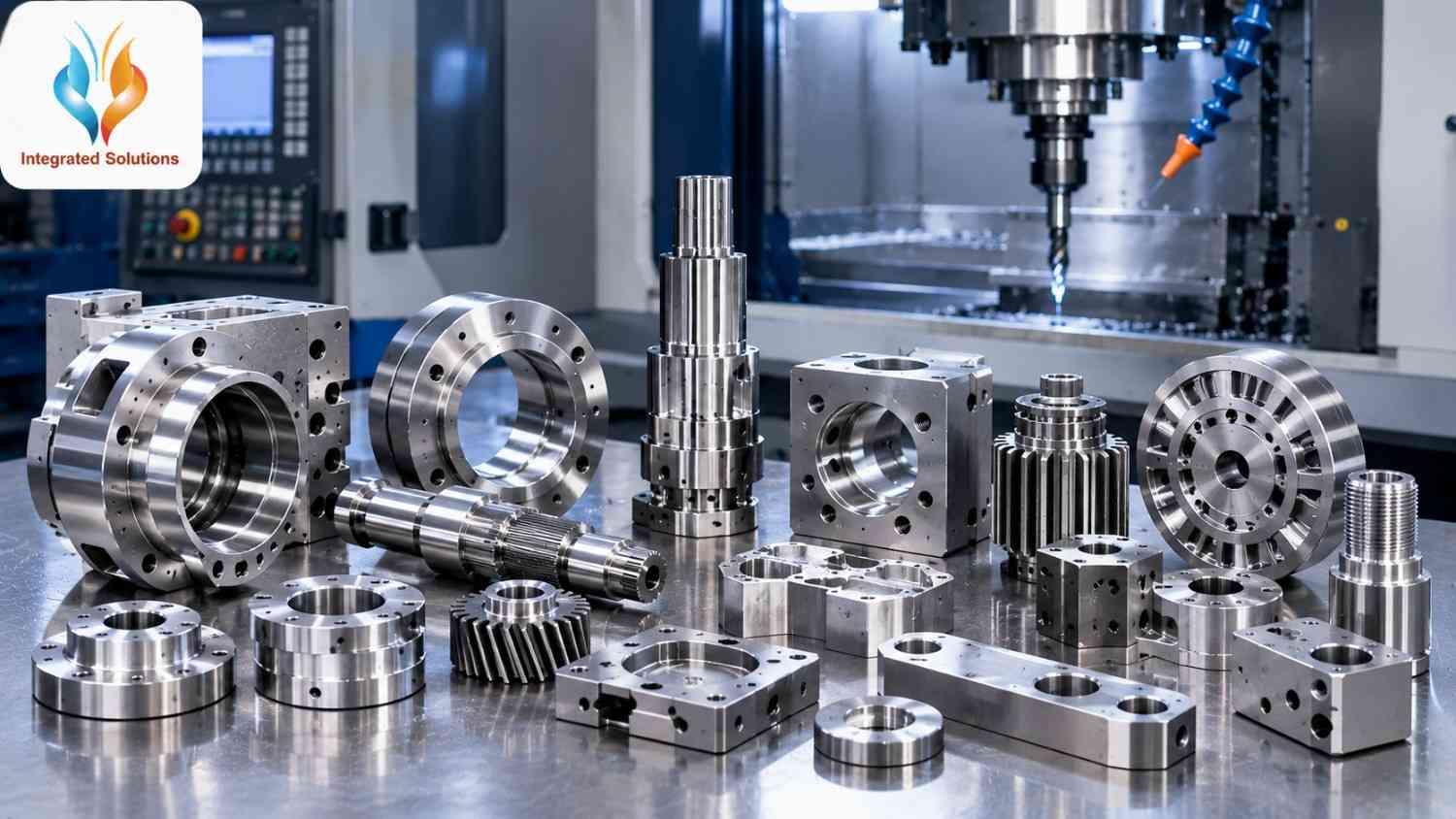
A drawing can look perfect on screen and still become scrap on the machine. That is where CNC Precision Components matter: dimensions, tolerances, material, finish, and assembly fit must repeat from batch to batch. Integrated Solutions states that it has worked in engineering and manufacturing since 2004. The real question is whether a supplier can make the same part again without starting a new quality dispute.
Most buyers compare piece price first.
That is backwards. A small saving means nothing if one rejected component delays a larger assembly.
CNC Precision Components: Specifications Buyers Should Lock Before Ordering
CNC Machined Components can involve turning, milling, drilling, boring, tapping, threading, grinding, and finishing. Integrated Solutions lists mild steel, stainless steel, aluminium, brass, copper, cast iron, and alloy steel among its machining materials.
Turned, Milled, and Complex Parts
Turned parts include shafts, bushes, pins, sleeves, and threaded parts. Milled parts include housings, brackets, plates, slots, pockets, and multi-face components. Complex parts may require multiple setups or multi-axis machining.
The detail buyers skip is datum control. A supplier can hit one diameter and still produce a useless part if hole position, flatness, perpendicularity, or concentricity is wrong relative to the mating feature.
Tolerances and Inspection
Integrated Solutions' Noida machining page states capability up to ±0.005 mm for selected work. That figure should not be copied onto every drawing. ISO 2768-1 specifies four general tolerance classes for dimensions without individual tolerance indications. Tight tolerances belong only where function needs them.
Typical Applications
Applications include automotive, electronics, aerospace-related parts, medical equipment, industrial machinery, defence, tooling, fixtures, housings, and shafts.
Five Supplier Checks That Expose Weak CNC Vendors
-
How are tolerances inspected? A strong answer names instruments, stages, and records. “Our operator checks everything” is weak.
-
What happens after a drawing revision? A capable supplier controls revision numbers. “Just WhatsApp the new drawing” is poor control.
-
Which dimensions are critical? Look for datums, fits, threads, and mating features. Treating every dimension equally is a bad sign.
-
How is material identity controlled? Ask for grade confirmation and traceability where required. “This is what we normally use” is not enough.
-
How does first-off approval work? Initial pieces should be checked before the full lot runs. Inspecting only after 500 parts are finished makes scrap expensive.
Integrated Solutions says its quality checks cover four areas: dimensional, material, tolerance, and performance inspection. Nobody tells you how messy revision control becomes when purchasing, production, inspection, and the operator use different files.
Key Benefits That Reduce Buyer Risk
Repeatability protects assembly time. Consistent mating parts reduce sorting, shimming, and rejection.
Programmed production supports repeat batches. Which means approved geometry can be reproduced without rebuilding the process manually.
Complex features can be combined. Fewer uncontrolled handoffs usually mean fewer location errors.
Controlled tolerances protect downstream parts. A 0.01 mm miss is twice a ±0.005 mm one-sided deviation.
Revision data is easier to reproduce. And yet automation does not fix poor document control; a supplier can machine the wrong revision perfectly.
Inspection records support acceptance decisions. Buyers get evidence instead of “quality is okay.”
Availability Across India Without Pretending Distance Does Not Matter
A CNC Precision Components Manufacturer in India still has to move raw material, samples, gauges, and finished lots. Integrated Solutions lists its location at Basai, Gurugram, Haryana 122006, with a factory area of 4,456.8 sq. ft.
For Delhi NCR buyers, shorter sample movement can help first-off approval and drawing corrections. Elsewhere, packaging, inspection documents, dispatch planning, and replacement-part lead time matter more than a “pan-India supply” claim.
Heavy parts and urgent replacements make geography expensive very quickly.
About Integrated Solutions
We have worked in engineering and manufacturing since 2004, with CNC/VMC machining alongside reverse engineering, tool design, jig and fixture work, mould development, plastic components, and sheet-metal work. Our published inspection process covers dimensional, material, tolerance, and performance checks.
We manufacture from customer drawings, samples, or ordered specifications. We also machine seven listed material groups: mild steel, stainless steel, aluminium, brass, copper, cast iron, and alloy steel.
Send us your 2D drawing or 3D model, material grade, quantity, critical tolerances, finish or coating requirement, and delivery location. We use those six inputs to review manufacturability and price the actual job.
We do not publish a fixed MOQ or guaranteed quote-response SLA on our website, so we will not invent one. Our MOQ is project-dependent, and our response timing should be confirmed when you submit the enquiry.
Conclusion
CNC Precision Components protect assembly time, repeat orders, and rejected-part cost—not just dimensional accuracy. Even a 0.01 mm miss can matter where a ±0.005 mm tolerance is functional. Buyers who demand clear drawing control, inspection, material confirmation, and first-off approval will be better prepared as parts become more complex.
FAQs
1. What are CNC Precision Components?
They are programmed-machined parts made to defined dimensions, geometry, tolerance, and finish. Production may combine turning, milling, drilling, boring, tapping, or grinding.
2. What is the difference between CNC Machined Components and ordinary machined parts?
CNC-controlled machining improves repeatability for recurring geometry. Manual machining still has a place for simple or one-off work, but operator dependence is usually higher.
3. What materials can a CNC Precision Components Manufacturer machine?
Common options include aluminium, mild steel, stainless steel, brass, copper, cast iron, and alloy steel. Caveat: machinability, heat, tool wear, and tolerance stability differ by grade.
4. How tight can CNC machining tolerances be?
Integrated Solutions states capability up to ±0.005 mm for selected work. That is not a blanket promise; size, geometry, material, setup, inspection method, and application all matter.
5. Which industries commonly use CNC parts?
Automotive, aerospace-related manufacturing, electronics, medical equipment, industrial machinery, defence, tooling, fixtures, and general engineering all use them.
6. How should I choose a CNC Precision Components Manufacturer in India?
Check revision control, material handling, first-off inspection, measurement capability, batch consistency, and corrective action. A supplier that quotes without asking about critical tolerances is pricing before understanding the job.
7. What should I send before requesting a quotation?
Send the latest drawing or model, material grade, quantity, critical dimensions, tolerances, finish requirement, and delivery location. A photo alone cannot define datums, fits, or acceptance limits.

 English
 Arabic
 French
 Spanish
 Portuguese
 Deutsch
 Turkish
 Dutch
Dutch
 Italiano
 Russian
 Portuguese (Brazil)
 Greek
Greek