


How do Modular Cardiac OT Setup Services Test Laminar Airflow Performance?
Introduction
Altus Airflow focuses on developing controlled healthcare environments where airflow performance plays an important role in maintaining suitable operating theatre conditions. In a cardiac operation theatre, laminar airflow systems are designed to provide controlled, unidirectional air movement over critical areas and help reduce the movement of airborne contaminants. Modular Cardiac OT Setup Services therefore need to test the airflow system carefully after installation to confirm that it operates according to the specified design parameters. Proper testing also helps identify airflow disturbances, pressure-related issues, filtration problems, and other installation defects before the OT becomes operational.
Laminar airflow testing is not limited to checking whether air is moving from the ceiling toward the operating zone. It involves several technical assessments, including airflow velocity, uniformity, air-change performance, pressure relationships, HEPA filter integrity, airflow visualization, temperature, humidity, and system balancing. Testing is generally performed using calibrated instruments and documented procedures. The results can then be compared with project specifications, applicable standards, equipment requirements, and hospital quality protocols. This systematic approach helps ensure that the installed ventilation system provides a controlled environment suitable for cardiac surgical activities.
1. Reviewing the Laminar Airflow Design
Before physical testing begins, the design and installation drawings are reviewed. The testing team examines the size of the laminar airflow ceiling, location of supply outlets, return-air arrangements, HEPA filter positions, operating table location, equipment layout, and HVAC configuration.
This review establishes the intended airflow pattern and identifies the critical areas that need testing. It also helps technicians understand the design airflow volume, target velocity, pressure relationships, and other project-specific requirements.
2. Inspecting the Installed System
A visual inspection is carried out before instruments are used. Technicians check whether ceiling modules, diffusers, HEPA filter housings, ducts, grilles, and access panels have been installed correctly.
They also look for visible gaps, damaged components, loose connections, obstructions, or installation conditions that could affect airflow. Any major physical issue should generally be corrected before performance testing continues.
3. Checking Airflow Velocity
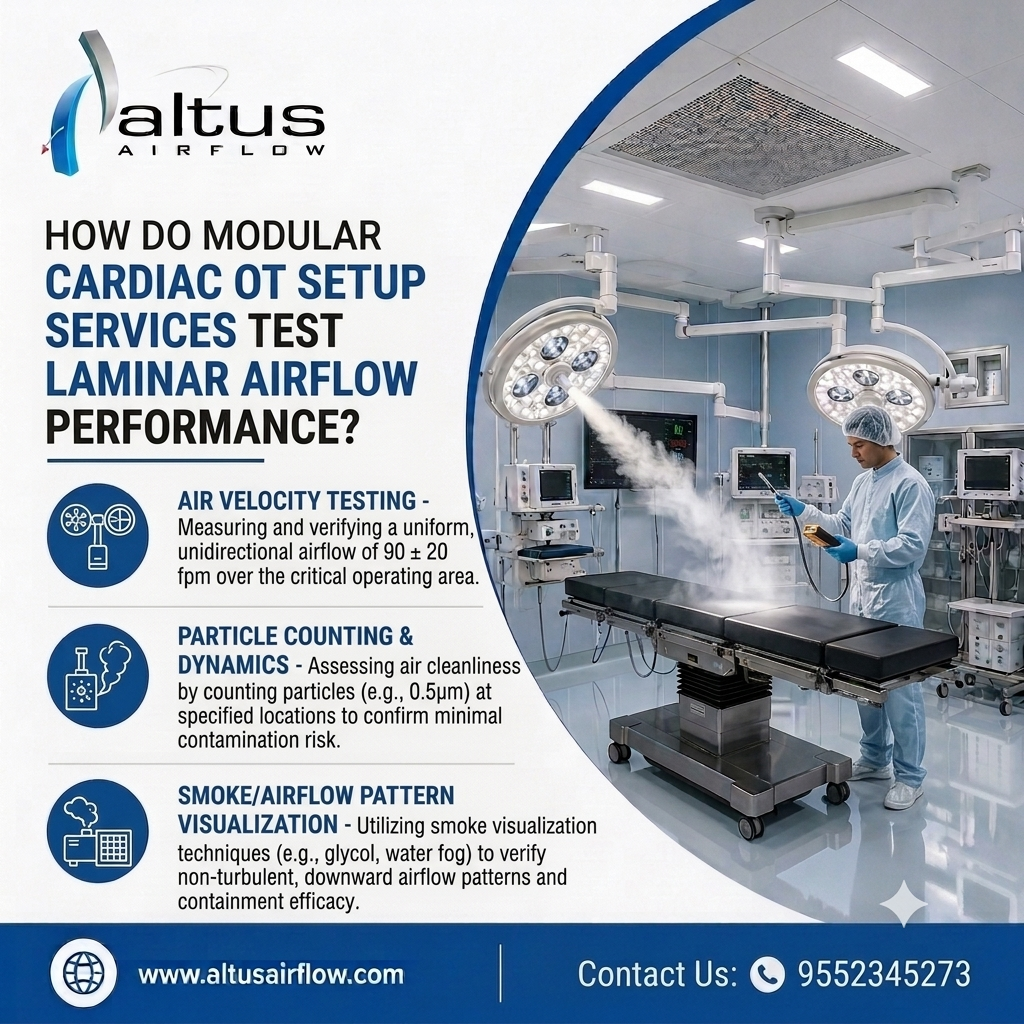
Air velocity is one of the important measurements in laminar airflow testing. A calibrated anemometer or suitable airflow instrument is used to measure the velocity at selected points beneath the laminar airflow canopy.
Multiple readings are normally taken across the critical airflow zone rather than relying on a single measurement. This provides a better understanding of whether air is being delivered consistently throughout the intended operating area.
4. Measuring Airflow Uniformity
Uniform airflow distribution is important because uneven velocity can create areas where the intended airflow pattern is disturbed. Technicians therefore take readings at a defined grid of measurement points.
The readings are compared to the specified project criteria. Significant variations may indicate balancing problems, filter loading, obstructions, incorrect diffuser settings, or other HVAC issues requiring investigation.
5. Performing Airflow Visualization Tests
Airflow visualization helps technicians observe how air travels through the operating area. A suitable visible tracer method can be used to demonstrate the direction and behavior of airflow.
The test can identify turbulence, reverse movement, dead zones, or disturbances created by equipment and room geometry. The objective is to verify that the intended airflow direction is maintained across critical areas under the specified test conditions.
6. Testing HEPA Filter Integrity
HEPA filters are a major component of controlled OT ventilation systems. Filter integrity testing helps identify leaks through the filter media, frame, seals, or installation points.
A suitable aerosol challenge and photometric measurement method may be used according to the applicable testing procedure. If leakage is detected, the filter installation or sealing arrangement needs to be investigated and corrected before final acceptance.
7. Measuring Air Changes
The ventilation system's air-change performance is assessed by determining the volume of air supplied to the room relative to the room volume. Airflow measurements from relevant supply and return points can be used for this calculation.
The resulting air-change rate is compared with the project specification or applicable healthcare ventilation requirements. This confirms whether the installed system is delivering the planned ventilation capacity.
8. Checking Room Pressure
Operating theatres normally require controlled pressure relationships with adjacent spaces. Differential pressure measurements help confirm that the room maintains the intended relationship with surrounding areas.
A calibrated differential pressure instrument can be used to measure the pressure difference between the OT and adjacent spaces. Unexpected pressure readings may indicate airflow imbalance, door leakage, incorrect return-air settings, or HVAC control problems.
9. Testing Temperature and Humidity
Temperature and humidity are also monitored during commissioning and performance testing. These conditions can influence staff comfort, equipment operation, and the overall controlled environment.
Readings are collected using calibrated temperature and humidity instruments. The results are compared with the project's specified operating range and hospital requirements.
10. Checking Supply and Return Air Balance
Air balancing confirms that the supply and return-air systems are working together as designed. Excessive supply air without appropriate return capacity, or insufficient supply airflow, can affect pressure and airflow behavior.
Technicians measure airflow from relevant supply and return points and adjust balancing devices where necessary. Proper balancing supports stable environmental conditions within the OT.
11. Examining Airflow Around Critical Areas
The operating table and surgical team area are considered important locations during airflow assessment. Testing focuses on whether the intended airflow reaches these critical zones without significant disruption.
Large surgical equipment, lights, pendants, monitors, and other installations can influence airflow. Therefore, testing under realistic room arrangements can provide useful information about actual airflow behavior.
12. Testing With Major Equipment in Position
A newly commissioned OT may perform differently once surgical equipment is installed. Equipment can obstruct or redirect airflow and create localized turbulence.
For this reason, testing may be performed with major fixed equipment installed in its intended position. This provides a more representative assessment of the completed environment and helps identify practical airflow issues before clinical use.
13. Assessing Ceiling Module Performance
Laminar airflow ceilings contain multiple components that must work together. The testing team checks whether the ceiling modules distribute air consistently across the designated area.
The condition of filters, frames, diffusers, seals, and supporting structures is also reviewed. Any irregularity can influence airflow distribution and should be addressed during commissioning.
14. Using Calibrated Testing Instruments
Reliable test results depend on suitable and calibrated instruments. Depending on the test, technicians may use anemometers, differential pressure meters, temperature and humidity meters, particle counters, aerosol photometers, and other specialized equipment.
Calibration records should be available for instruments used during validation. This creates greater confidence that recorded measurements accurately represent the system's performance at the time of testing.
15. Conducting Particle Monitoring
Particle monitoring may be performed where required by the project specification or applicable healthcare protocol. Particle counts can provide information about the cleanliness characteristics of the controlled environment.
Measurements may be taken at designated locations and under defined operating conditions. The results can then be documented and assessed against the applicable acceptance criteria.
16. Evaluating Airflow Under Different Conditions
Airflow performance can be affected by operating conditions such as door movement, equipment placement, HVAC loading, and occupancy. Depending on the validation plan, selected tests may therefore be conducted under defined operational conditions.
This helps establish whether the ventilation system remains reasonably stable when the OT is used as intended rather than only when the room is empty.
17. Identifying Airflow Disturbances
Airflow visualization and velocity measurements can reveal disturbances caused by surgical lights, ceiling-mounted equipment, equipment towers, or other obstructions.
When disturbances are identified, the testing team can review their source and recommend suitable adjustments. This may include repositioning equipment, modifying airflow components, or balancing the HVAC system.
18. Performing HVAC Balancing Adjustments
If measurements do not meet specified requirements, HVAC balancing may be required. Dampers, airflow settings, fan parameters, or other controllable components may be adjusted where appropriate.
After adjustments, the relevant tests should be repeated. This confirms whether the corrective action has produced the required improvement rather than relying on assumptions.
19. Repeating Tests After Corrective Actions
Testing is often an iterative process. If a measurement falls outside the acceptance criteria, the issue is investigated and corrective action is implemented.
The affected parameter is then retested. Repeating the measurement provides documented evidence that the correction has addressed the identified issue.
20. Documenting Test Results
A complete validation report should record the test method, equipment used, measurement locations, readings, environmental conditions, acceptance criteria, and final results.
Photographs, airflow visualization records, calibration certificates, filter test reports, and balancing records may also form part of the documentation package. Proper documentation supports future maintenance and technical reviews.
Comparing Results With Acceptance Criteria
Test results need to be evaluated against clearly defined acceptance criteria. These criteria may come from the project specifications, hospital requirements, equipment manufacturers, applicable standards, and relevant healthcare engineering practices.
This comparison determines whether each tested parameter meets the requirements established for the particular OT. Acceptance criteria should be agreed upon during the project planning stage wherever possible.
Preparing the Validation Report
A validation report brings the individual test results together into a structured record. It normally includes system information, test procedures, instrument details, readings, deviations, corrective actions, and final observations.
A well-prepared report provides the hospital with technical evidence of the ventilation system's commissioning status and creates a reference point for future inspections.
Role of Modular Cardiac OT Setup Services
Modular Cardiac OT Setup Services may cover different levels of testing depending on the project's scope. A turnkey provider may coordinate HVAC testing, balancing, HEPA integrity testing, airflow visualization, environmental measurements, and documentation through its internal team or qualified specialist agencies.
Hospitals should confirm in advance which tests are included in the contract and who is responsible for conducting, witnessing, reviewing, and approving each validation activity. Clear responsibility prevents gaps during commissioning and handover.
Importance of Post-Installation Testing
Post-installation testing helps identify problems before the OT is handed over for routine clinical use. Even a correctly designed system can require balancing or adjustment after installation.
Testing also establishes baseline performance data. These baseline measurements can be useful during future preventive maintenance, troubleshooting, periodic validation, or system modifications.
What Hospitals Should Check Before Final Acceptance?
Hospitals should review whether all required airflow and HVAC tests have been completed and properly documented. They can request test reports, calibration certificates, HEPA filter integrity results, airflow measurements, pressure readings, and corrective-action records where applicable.
It is also useful to confirm whether the system has been tested in its final configuration and whether the operating team has received relevant information about monitoring, alarms, maintenance, and periodic testing.
Conclusion
Proper laminar airflow testing is an important part of commissioning a controlled cardiac operating theatre. Altus Airflow approaches such projects by considering airflow distribution, velocity, uniformity, filtration, pressure, environmental conditions, and system balancing as interconnected performance factors. Altus Airflow can support a structured testing and documentation process so hospitals can evaluate whether the installed ventilation system meets its defined project requirements before handover.
FAQs
1. How do Modular Cardiac OT Setup Services test laminar airflow performance?
Modular Cardiac OT Setup Services test laminar airflow using measurements such as airflow velocity, uniformity, visualization, HEPA filter integrity, air changes, pressure differential, and environmental monitoring.
2. Why is airflow visualization performed in a cardiac OT?
Airflow visualization helps identify the direction of air movement and reveals turbulence, dead zones, or disturbances around critical operating areas.
3. What instruments are used for laminar airflow testing?
Common instruments include calibrated anemometers, differential pressure meters, temperature and humidity meters, particle counters, and aerosol photometers, depending on the required tests.
4. Is HEPA filter testing part of OT validation?
HEPA filter integrity testing may form an important part of ventilation validation. It helps identify leakage through filter media, frames, or sealing points.
5. Why is HVAC balancing necessary?
HVAC balancing helps ensure that supply and return airflow are appropriately adjusted to support the required pressure, ventilation, and airflow conditions.
Read Our Previous Blog --------------->Does a Modular Cardiac OT Turnkey Project Company perform OT validation testing?

 English
 French
 Spanish
 Portuguese
 Deutsch
 Turkish
 Dutch
Dutch
 Italiano
 Russian
 Romaian
 Portuguese (Brazil)
 Greek
Greek