


Electric Barrel Pump: Working, Benefits, Types, and Applications
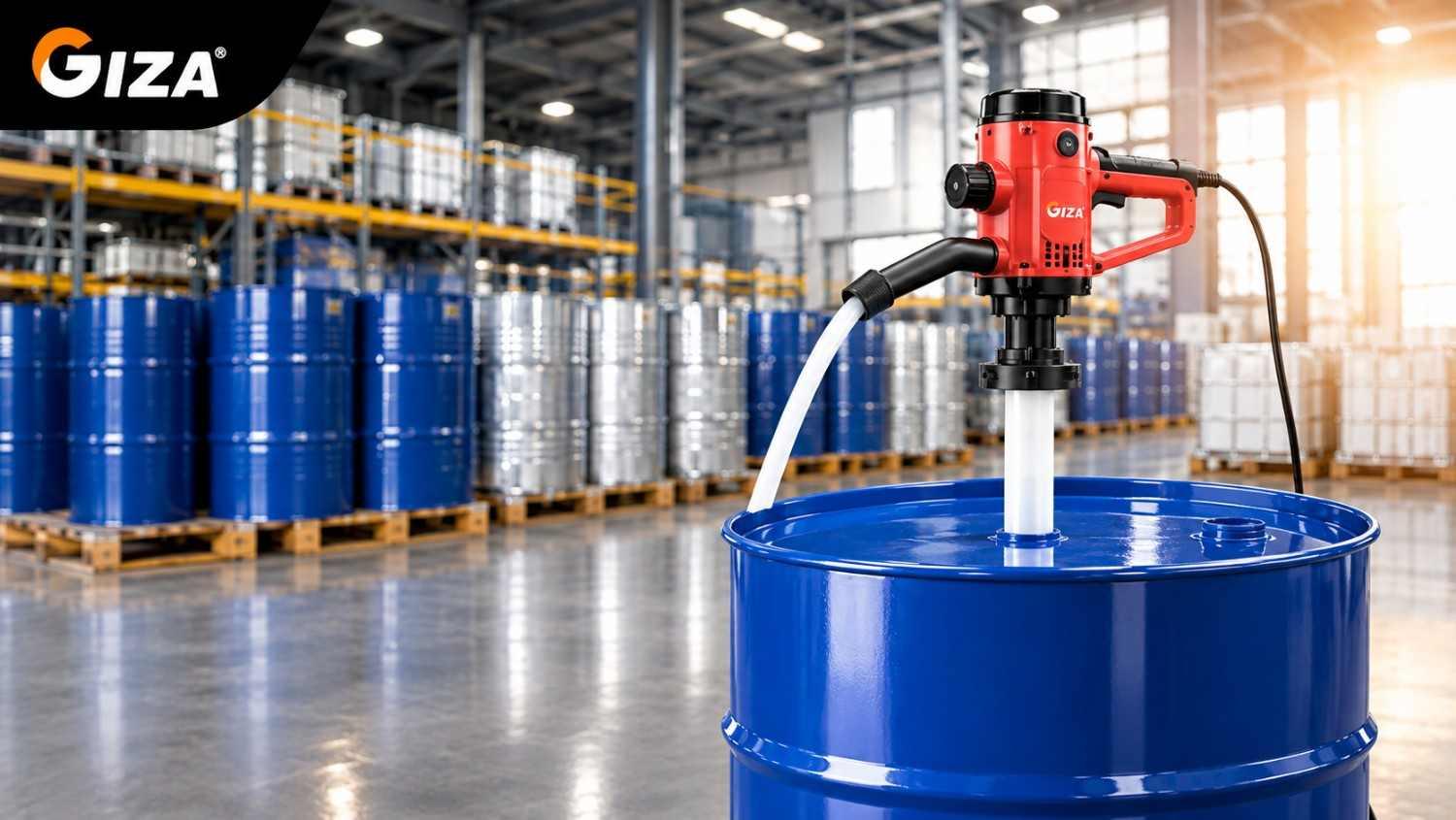
The drum is full, production needs the liquid now, and somebody is still using a slow hand pump. That is where an Electric Barrel Pump earns its place. A motor drives the pumping element while an immersion tube draws liquid from the barrel into a hose, tank, or process line. Giza states that its manufacturing operation dates to 1999 and records more than 27 years of pump-industry experience.
Most buyers make the same mistake: they ask for “an electric pump” before stating the liquid, viscosity, temperature, and duty cycle. That is backwards. Match the pump to the fluid first.
What Actually Determines Electric Barrel Pump Performance
How an Electric Barrel Pump Works
The motor drives an impeller, rotor, or similar pumping element. Liquid enters near the bottom of the immersion tube and leaves through the discharge connection. Actual output depends on pump design, motor speed, viscosity, discharge head, and tube length.
Types, Materials and Applications
Giza lists four principal construction options for its electric range: SS304/SS316, polypropylene (PP), PVDF, and cast iron. Stainless steel is positioned for oils, fuels, lubricants, and selected process liquids. PP and PVDF are intended for applications where chemical resistance becomes more critical. Cast iron is offered for heavier mechanical-duty requirements.
Nobody tells you this often enough: tube material alone is not a compatibility check. Finish Thompson notes that transferred liquid contacts components beyond the outer tube, including other wetted parts. Published electric drum-pump designs also vary dramatically—one polypropylene model is rated up to 151 L/min, while a progressive-cavity model can handle viscosity up to 100,000 cP at lower flow.
Typical applications include drum emptying, lubricant transfer, solvent handling, chemical dosing, tank transfer, production-line feeding, and maintenance work. One pump design will not perform all seven jobs equally well.
Five Checks Before You Approve a Supplier
-
Fluid compatibility: Give the exact liquid, concentration, and operating temperature. A bad answer is: “SS works with chemicals.”
-
Viscosity and flow: Specify viscosity in cP and required L/min. A bad answer is a flow figure with no conditions attached; published drum-pump designs range from around 50 cP to 100,000 cP capability depending on construction.
-
Duty cycle: State whether the pump operates for three minutes occasionally or repeatedly throughout a shift. A bad answer is “continuous duty” with no motor or operating limit.
-
Safety environment: Ask about grounding, motor type, and hazardous-area suitability. A bad answer is “electric is fine everywhere.” OSHA guidance for certain Class IA liquid transfers specifically addresses electrically grounded metallic suction pumps.
-
After-sales support: Ask who handles pump selection, spares, and failures after dispatch. A bad answer is “call us later.” Giza publishes an enquiry-response target of under 48 hours.
Where the Pump Protects Time and Margin
Faster Transfer, Less Labour
Electric drive removes repeated hand cranking and makes frequent drum emptying more practical, particularly where operators handle several containers during a working shift.
Lower Spill Exposure
Controlled liquid movement can reduce product loss, cleanup work, and housekeeping time.
A cheap pump that drips solvent every day is not cheap.
Better Material Matching
Choosing PP, PVDF, stainless steel, or cast iron against the actual fluid helps protect pump life and replacement cost. Which means chemical compatibility is a purchasing decision with a direct cost consequence.
More Predictable Production
Stable transfer supports filling, dosing, and production-line feeding. Giza reports more than 90% repeat orders across its pump business. That is a company-published figure rather than an independent audit, so procurement teams should verify it during vendor evaluation.
Lower Operator Effort
Electric operation reduces the physical work involved compared with repeated manual pumping. And yet, electrical convenience does not cancel the need to select the correct motor and safety arrangement for the operating environment.
Buying Electric Barrel Pumps Across India
Giza operates from Shapar, Rajkot, Gujarat, and markets its products for nationwide supply. As one of the Electric Barrel Pump Suppliers in India, it states that stock support is available for urgent requirements and that pan-India delivery forms part of its supply model.
For procurement teams comparing Electric Barrel Pump Dealers or Wholesalers, location is a supply-chain issue, not simply an address. Ask how quickly a replacement unit can reach your plant. Giza’s published under-48-hour enquiry response gives buyers one measurable service commitment to hold the supplier against.
About Giza Pumps
We have been manufacturing since 1999, with more than 27 years of stated industry experience. We manufacture in-house rather than simply relabelling sourced pumps, and our wider production range works with material grades including SS304, SS316, SS316L, PP, PVDF, cast iron, and Teflon.
We match pump selection to fluid type, viscosity, and actual usage before dispatch because discovering a compatibility mistake after the pump reaches the factory is harder and more expensive to fix.
Send us the liquid name, concentration, viscosity, operating temperature, drum size, required flow, daily transfer volume, available power supply, and whether flammable vapours may be present. We will use those details to narrow the appropriate Giza Pumps configuration.
Our published enquiry-response target is under 48 hours. For order quantity, we accept single-pump requirements as well as bulk and customised orders; we confirm any model-specific commercial MOQ in the quotation.
Conclusion
An Electric Barrel Pump is only a simple purchase when the liquid is simple. With four principal construction options listed by Giza, material compatibility, viscosity, duty cycle, and electrical safety still decide whether the pump becomes a dependable production tool or an avoidable maintenance problem.
Start the next purchase with the fluid data sheet, not the lowest unit price.
FAQs
1. What is an Electric Barrel Pump used for?
It moves compatible liquids from drums or barrels into tanks, process lines, or smaller containers. Common duties include oils, lubricants, fuels, solvents, and industrial chemicals.
2. What should I ask Electric Barrel Pump Manufacturers before buying?
Ask for wetted-material compatibility, viscosity range, expected flow, duty cycle, motor type, and spare support. If Electric Barrel Pump Manufacturers cannot relate those answers to your actual fluid, the quotation is incomplete.
3. Are Electric Barrel Pump Dealers suitable for urgent replacement orders?
They can be if the correct unit is genuinely in stock. Electric Barrel Pump Dealers should still confirm the exact model and wetted materials before dispatch; “same size” does not mean chemically compatible.
4. Do Electric Barrel Pump Wholesalers handle bulk requirements?
Giza states that it supports bulk and customised requirements. The caveat is that Electric Barrel Pump Wholesalers may face different availability by model, so get quantity, configuration, and dispatch timing in writing.
5. How do Electric Barrel Pump Suppliers in India select the right material?
Start with the liquid, concentration, temperature, viscosity, and every wetted component. Electric Barrel Pump Suppliers in India may offer stainless steel or engineering polymers, but no single construction material is suitable for every liquid.
6. Can one electric barrel pump handle both oils and corrosive chemicals?
Do not assume it can. Giza lists SS304/316, PP, PVDF, and cast-iron alternatives because different fluids require different construction. Confirm compatibility before changing the liquid being transferred.
7. Is an electric model always better than a manual or air-operated pump?
No. Electric models make sense for frequent powered transfer, but hazardous environments may require a specifically suitable motor or another drive method. OSHA’s flammable-liquid guidance shows why electrical grounding conditions cannot be ignored.

 English
 Arabic
 French
 Spanish
 Portuguese
 Deutsch
 Turkish
 Dutch
Dutch
 Italiano
 Russian
 Romaian
 Portuguese (Brazil)