


AI Skills Roadmap 2026: What Should You Learn to Build an AI Career?
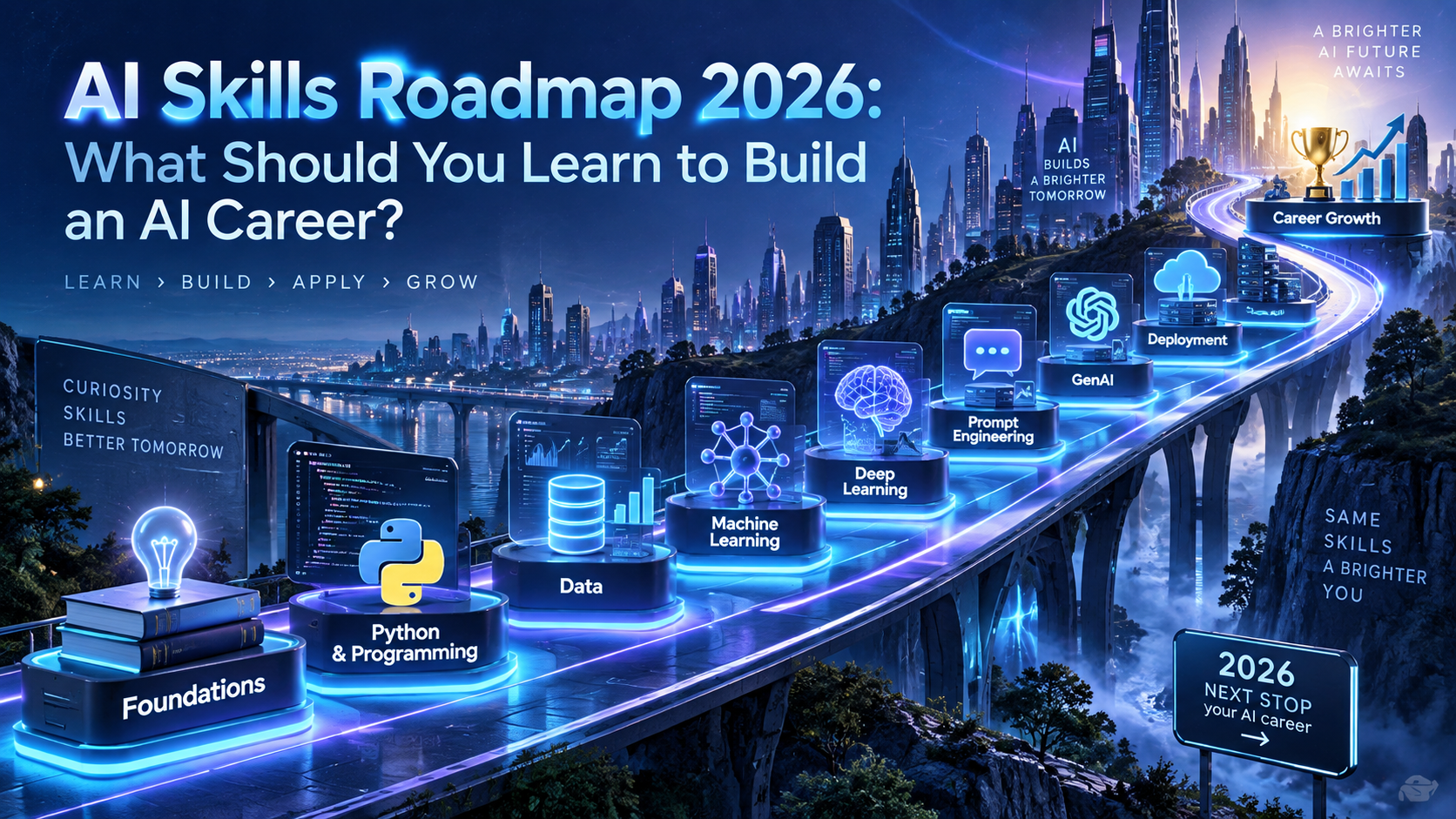
Building an AI career in 2026 requires much more than learning how to write prompts.
Modern AI roles increasingly combine software engineering, machine learning, generative AI, data, agents, cloud deployment, evaluation, and MLOps. Professionals who can move from a model prototype to a reliable production system are especially valuable.
A practical AI roadmap looks like this:
Python → Math and Data → Machine Learning → Deep Learning → LLMs → RAG → AI Agents → Cloud → MLOps → Evaluation and Security
Recent 2026 skills reports also show rapid growth in generative AI learning and increased importance of critical thinking alongside technical AI skills.
Watch Cert Mage YouTube video for a complete and easy explanation.
AI Skills Roadmap at a Glance
|
Stage |
Main Skills |
Career Direction |
|
Beginner |
Python, SQL, statistics, Git |
AI foundations |
|
Early Technical |
ML, data analysis, model evaluation |
Data/ML roles |
|
Intermediate |
Deep learning, transformers, LLMs |
AI engineering |
|
Applied GenAI |
Prompting, APIs, RAG, vector databases |
GenAI development |
|
Advanced |
Agents, MCP, multi-agent systems |
Agentic AI |
|
Production |
Cloud, Docker, CI/CD, MLOps, observability |
Production AI |
|
Senior |
Evaluation, governance, security, architecture |
AI architecture/leadership |
1. Start With Python
Python remains one of the most important foundational skills for AI.
You should be comfortable with:
-
Variables
-
Data types
-
Functions
-
Loops
-
Classes
-
File handling
-
APIs
-
Virtual environments
You do not need to become an advanced software engineer before learning AI, but weak programming foundations will make everything harder later.
A good first milestone is being able to build a simple Python application that:
-
Reads data
-
Processes it
-
Calls an API
-
Returns a usable result
2. Learn SQL and Data Fundamentals
AI systems depend on data.
Before focusing heavily on models, learn how to:
-
Query databases
-
Clean datasets
-
Join tables
-
Filter records
-
Aggregate data
-
Handle missing values
SQL remains especially useful because real AI applications often need to work with structured enterprise data.
You should also understand basic tools such as:
-
Pandas
-
NumPy
-
DataFrames
-
CSV and JSON
3. Build Basic Math and Statistics Knowledge
You do not need a mathematics degree to start AI engineering.
However, you should understand:
-
Probability
-
Mean and variance
-
Distributions
-
Linear algebra basics
-
Gradients
-
Evaluation metrics
These concepts help you understand why models behave differently instead of simply copying code.
The goal is practical understanding.
4. Learn Machine Learning Fundamentals
Machine learning provides the foundation for understanding more advanced AI systems.
Important concepts include:
-
Supervised learning
-
Unsupervised learning
-
Regression
-
Classification
-
Clustering
-
Feature engineering
-
Training and validation
-
Overfitting
-
Model evaluation
Learn a practical library such as:
scikit-learn
Build projects rather than only watching tutorials.
Examples:
-
Customer churn prediction
-
Fraud classification
-
House-price prediction
5. Learn Deep Learning
After traditional ML, move into neural networks.
Important areas include:
-
Neural network architecture
-
Backpropagation
-
Embeddings
-
CNNs
-
Sequence models
-
Transformers
A framework such as PyTorch is especially useful.
You do not need to train huge models.
The objective is to understand the building blocks behind modern AI.
6. Understand LLM Fundamentals
Large language models are central to many AI careers in 2026.
You should understand:
-
Tokens
-
Context windows
-
Embeddings
-
Sampling
-
Temperature
-
Reasoning
-
Tool calling
-
Function calling
-
Model selection
A recent AI engineering skills map highlights LLM foundations as one of the core areas needed to build and deploy AI applications.
Do not treat an LLM as a magical black box.
Learn its strengths, limitations, and failure modes.
7. Learn Prompt Engineering Properly
Prompting is useful, but it should be treated as one skill within a larger AI system.
Learn:
-
Zero-shot prompting
-
Few-shot prompting
-
Structured outputs
-
Role instructions
-
Prompt templates
-
Context management
-
Prompt evaluation
A strong AI professional knows when prompt changes are enough and when the real problem requires:
-
Better data
-
Retrieval
-
Tool use
-
Model change
-
Architecture change
8. Learn Retrieval-Augmented Generation
RAG is one of the most practical enterprise AI skills.
A RAG system combines an LLM with external data.
Learn:
-
Chunking
-
Embeddings
-
Vector search
-
Retrieval
-
Reranking
-
Context injection
-
Response generation
Useful technologies include:
-
Vector databases
-
Search systems
-
Document pipelines
Build a project such as:
PDF knowledge assistant → document ingestion → embedding → retrieval → LLM response
This is one of the most valuable portfolio projects for an aspiring AI engineer.
9. Learn AI Agents
Agentic AI is one of the biggest developments in 2026.
Google Cloud's current agent training emphasizes execution loops, external tools, memory, multi-agent systems, MCP, observability, and production deployment.
An AI agent typically combines:
Model + instructions + tools + memory + execution loop
Learn:
-
Tool calling
-
Planning
-
State
-
Memory
-
Human-in-the-loop
-
Multi-step workflows
-
Multi-agent orchestration
This is where AI moves from simply generating answers to performing actions.
10. Learn Model Context Protocol
MCP has become increasingly important for connecting AI systems to external tools and data.
You should understand:
-
Hosts
-
Clients
-
Servers
-
Tools
-
Resources
-
External service integration
MCP skills are especially useful when building agents that need to interact with:
-
Databases
-
APIs
-
Files
-
Enterprise systems
Modern agent training increasingly treats this type of integration as a production skill rather than an optional extra.
11. Learn One Cloud Platform
Production AI systems usually run in the cloud.
Choose one platform first:
-
AWS
-
Azure
-
Google Cloud
Learn:
-
Compute
-
Storage
-
IAM
-
APIs
-
Networking
-
Monitoring
-
Serverless services
-
Containers
Then add AI-specific services.
For example:
AWS
Bedrock and AI/ML services
Azure
Microsoft Foundry and Azure AI
Google Cloud
Vertex AI and Gemini
Do not try to master all three at the same time.
12. Learn Docker and Deployment
A project is much more valuable when other people can actually use it.
Learn:
-
Docker
-
REST APIs
-
FastAPI
-
Environment variables
-
Secrets
-
Logging
Then deploy your application.
A strong milestone is:
Local prototype → container → cloud deployment → monitored application
13. Learn MLOps and LLMOps
Building a model is only one part of the job.
Production AI requires:
-
Version control
-
CI/CD
-
Experiment tracking
-
Model monitoring
-
Prompt versioning
-
Evaluation
-
Logging
-
Rollbacks
The same applies to AI agents.
Google Cloud's 2026 agent training now explicitly includes AgentOps, observability, monitoring, CI/CD, and security for production agents.
These skills become increasingly important as you move beyond beginner projects.
14. Learn AI Evaluation
Evaluation is one of the most underrated AI engineering skills.
You need to know whether your system is actually improving.
Learn to evaluate:
-
Accuracy
-
Relevance
-
Groundedness
-
Hallucination
-
Latency
-
Cost
-
Safety
-
Retrieval quality
Andrew Ng's 2026 AI engineering skills map identifies evaluation-driven development as a core capability for production AI systems.
Do not rely only on:
"This output looks good."
Use measurable criteria.
15. Learn AI Security and Governance
AI introduces new risks.
Important areas include:
-
Prompt injection
-
Data leakage
-
Access control
-
Secrets management
-
Model abuse
-
Output filtering
-
Data privacy
Agentic systems add additional complexity because they can take actions.
That means you also need to think about:
-
Tool permissions
-
Human approval
-
Audit logs
-
Guardrails
Security should be built into the system from the beginning.
16. Build a Portfolio
Your portfolio is one of the most important parts of an AI career.
Aim for several projects that demonstrate different capabilities.
Project 1: Basic ML
Build a predictive model.
Project 2: RAG Application
Build a document assistant.
Project 3: AI Agent
Build an agent that uses external tools.
Project 4: Production AI App
Deploy an AI application with:
-
Authentication
-
Logging
-
Monitoring
-
Evaluation
A portfolio should show what you can actually build.
How Practice Resources Can Support Your AI Learning Path
As you move through different AI technologies, Cert Mage can complement your learning through IT and AI certification preparation resources alongside hands-on projects, official training, cloud labs, and structured exam study.
Certification can help organize your learning, but real projects are what turn knowledge into usable skills.
Which AI Career Should You Choose?
Different AI roles require different depth.
AI Engineer
Focus on:
-
Python
-
APIs
-
LLMs
-
RAG
-
Agents
-
Cloud deployment
Machine Learning Engineer
Focus on:
-
ML
-
Deep learning
-
Model training
-
Data pipelines
-
MLOps
Generative AI Developer
Focus on:
-
LLM APIs
-
RAG
-
Agents
-
Evaluation
-
Tool integration
MLOps Engineer
Focus on:
-
Infrastructure
-
CI/CD
-
Monitoring
-
Model deployment
-
Cloud
AI Solutions Architect
Focus on:
-
Architecture
-
Security
-
Cost
-
Reliability
-
Integration
Suggested 6-Month AI Learning Plan
Month 1
Learn:
-
Python
-
SQL
-
Git
-
Data fundamentals
Month 2
Study:
-
Machine learning
-
Statistics
-
scikit-learn
Month 3
Learn:
-
Deep learning
-
PyTorch
-
Transformers
-
LLM fundamentals
Month 4
Build:
-
Prompt applications
-
RAG
-
Vector-search projects
Month 5
Learn:
-
AI agents
-
Tool calling
-
MCP
-
Multi-step workflows
Month 6
Focus on:
-
Cloud deployment
-
Docker
-
Evaluation
-
MLOps
-
Security
Then build one polished end-to-end portfolio project.
Common AI Learning Mistakes
Avoid:
-
Learning only prompts
-
Collecting AI tools without fundamentals
-
Ignoring programming
-
Skipping data skills
-
Avoiding deployment
-
Building only tutorial projects
-
Ignoring evaluation
-
Ignoring security
-
Chasing every new framework
Frameworks change quickly.
Core skills last much longer.
What Matters Most in 2026?
One of the clearest trends in 2026 is that AI careers increasingly require people who can build reliable systems, not just demonstrate models.
That means high-value skills include:
-
LLM fundamentals
-
Data grounding
-
Agentic systems
-
Evaluation
-
Production operations
-
Software engineering
These themes appear consistently in current AI engineering skill maps and agent-training programs.
Final AI Skills Roadmap
A practical sequence is:
Python
↓
Data + SQL
↓
Machine Learning
↓
Deep Learning
↓
LLMs
↓
RAG
↓
AI Agents
↓
Cloud
↓
MLOps / LLMOps
↓
Evaluation + Security
↓
Production AI Projects
Do not rush through the roadmap.
Build something at every stage.
Conclusion
The best AI career strategy in 2026 is not to learn every new tool.
It is to build strong foundations and then progress toward production skills.
Start with:
Python → data → machine learning
Then move into:
LLMs → RAG → AI agents
Finally, learn:
cloud → deployment → MLOps → evaluation → security
Current skills data also shows rapid growth in generative AI learning while emphasizing the importance of critical thinking, indicating that successful AI professionals need both technical and analytical capabilities.
The strongest career profile is:
AI knowledge + software skills + projects + deployment experience
That combination gives you a much stronger foundation for an AI career than certifications or tutorials alone.
FAQs
What should I learn first for an AI career?
Start with Python, SQL, basic statistics, and data handling before moving into machine learning and generative AI.
Do I need mathematics for AI?
Yes, but beginners only need practical foundations in statistics, probability, linear algebra, and model evaluation before progressing further.
Are AI agents important in 2026?
Yes. Current industry training places significant emphasis on autonomous agents, tool integration, memory, multi-agent systems, and production AgentOps.
Should I learn RAG before AI agents?
Usually yes. Understanding retrieval, embeddings, and grounding helps you build more reliable agentic systems.
Which cloud is best for an AI career?
AWS, Azure, and Google Cloud all provide strong AI platforms. Choose one first and build practical deployment experience before learning another.
Are certifications enough for an AI career?
No. Certifications can support structured learning, but employers also value programming, projects, deployment skills, evaluation, and practical experience.
Read More: Microsoft Practice Tests: How Effective Are They for Exam Preparation?

 English
 Arabic
 Spanish
 Portuguese
 Deutsch
 Turkish
 Dutch
Dutch
 Italiano
 Russian
 Romaian
 Portuguese (Brazil)
 Greek
Greek